Product update · October 19, 2026
Six weeks of work shipped since the last update. Corticorp Finance grew from 26 funds to 44 live funds, and its Market Pulse became a daily markets newspaper: seven editions every weekday, four interactive desk tools beside them, and a share card with a real chart for every edition. Over on Corticorp News, every story and every section can be shared with a preview card of its own.
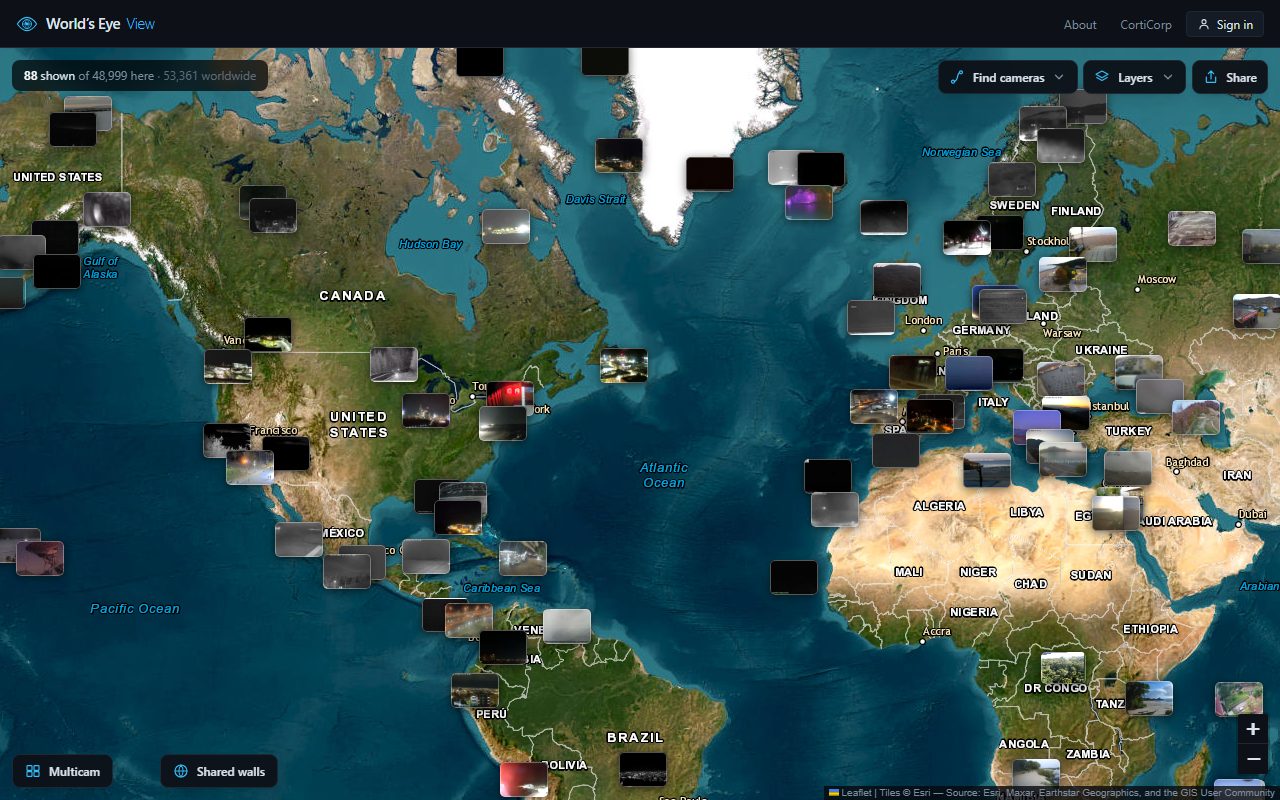
World's Eye View passed 53,000 cameras. And a brand-new project, the Open Page Document, went from an empty repository to a working viewer, editor and PDF importer in four days.
Finance
On October 8 the thirteen advanced, model-driven strategists were paused to save cost, together with the Judge, the Scientist and the Treasurer on the Board. The regular funds restarted that day from a common starting value, which the site calls run two; the earlier run is kept as a closed record, and no data was deleted. The last update counted 39 portfolios, 26 regular and 13 advanced. The public figure is now 44 live and 13 paused.
The eighteen new funds arrived on October 17 in three families. Size and Style holds eight, among them Value, Growth, Mega Caps and Large Caps. Bonds and Credit holds three: Inflation Protected, Leveraged Loans and High Yield Bonds. Sectors and Commodities holds seven, from Emerging Markets and Regional Banks to Semiconductors and Copper. Each family shares one philosophy, but each fund holds its own instrument, and a few are shown data of their own: credit spreads for the credit funds, crop prices and positioning for agriculture, real yields for Inflation Protected. Every fund has its own icon, every portfolio starts at $100,000, and a fund under twenty sessions old is marked "too new to rank".
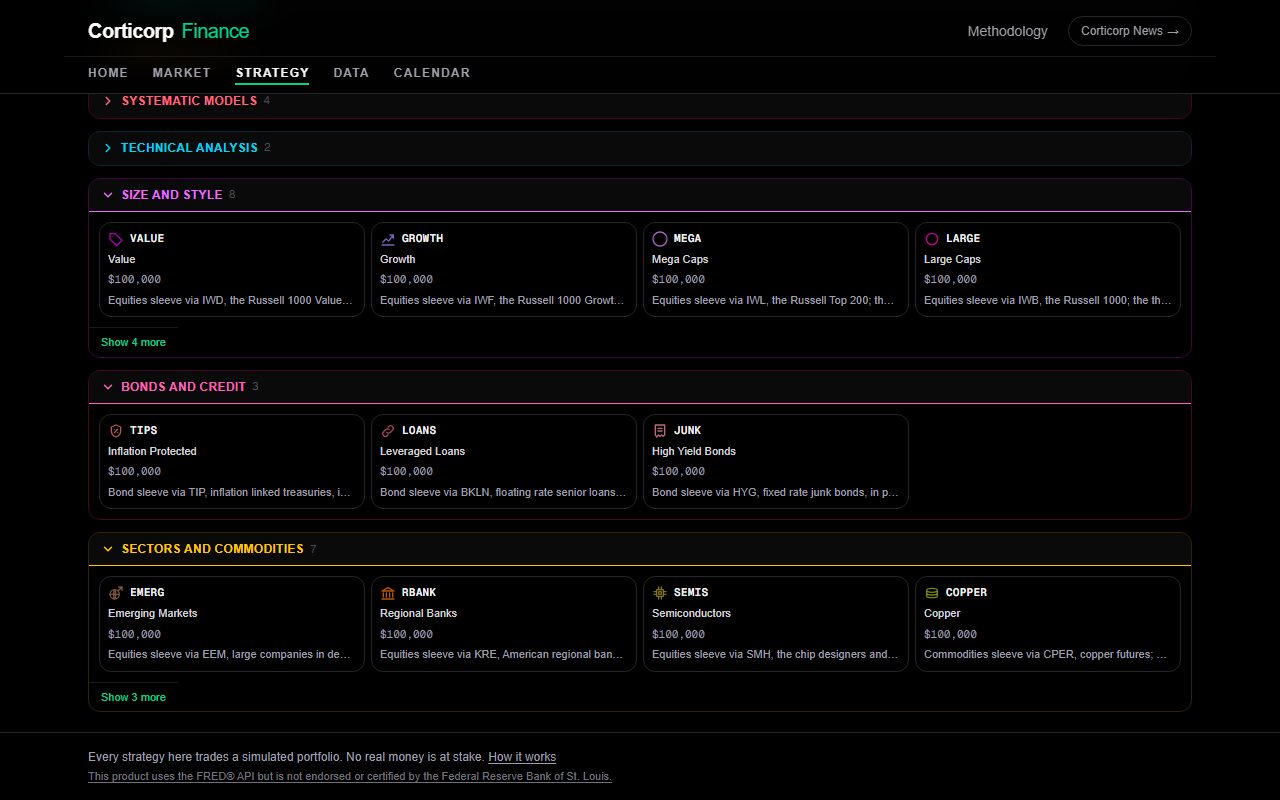
Simulated portfolios. A research experiment, not investment advice.
Finance
The Market Pulse used to be six editions written twice a weekday. It is now a daily markets newspaper with seven: Overview, Equities, Sector, Macro, Commodities, Physical World and News. The open edition goes out at 9:32am ET and the close edition at 4:15pm ET, with Physical World once a day. Each edition has its own sections, a named desk voice, a three-paragraph opening and a permanent dated page, so Friday's Sector edition lives at an address of its own, such as /markets/pulse/2026-10-16/sector, and stays there.
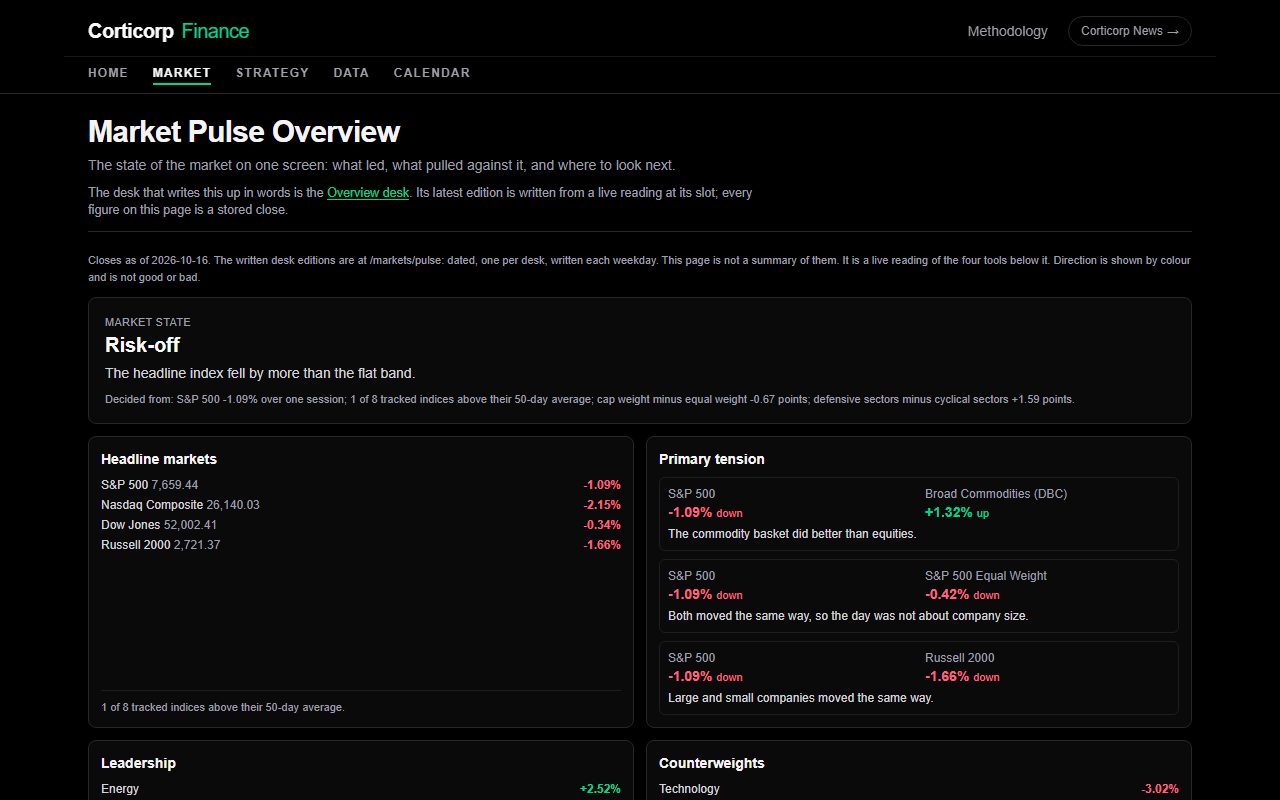
Four interactive desk tools arrived between September 22 and October 6: Market Anatomy, which shows what moved and why; the Commodity Explorer, with flow diagrams from the upstream driver to the commodity to where it goes; the Global Macro Dashboard; and the Physical situation map. Each sits beside its edition under a Review tab, and every day's tool keeps its own address, for example /markets/anatomy/2026-10-17. The Overview and Sector Supply Lines, which prices commodity routes end to end with real freight rates, both arrived on October 3.
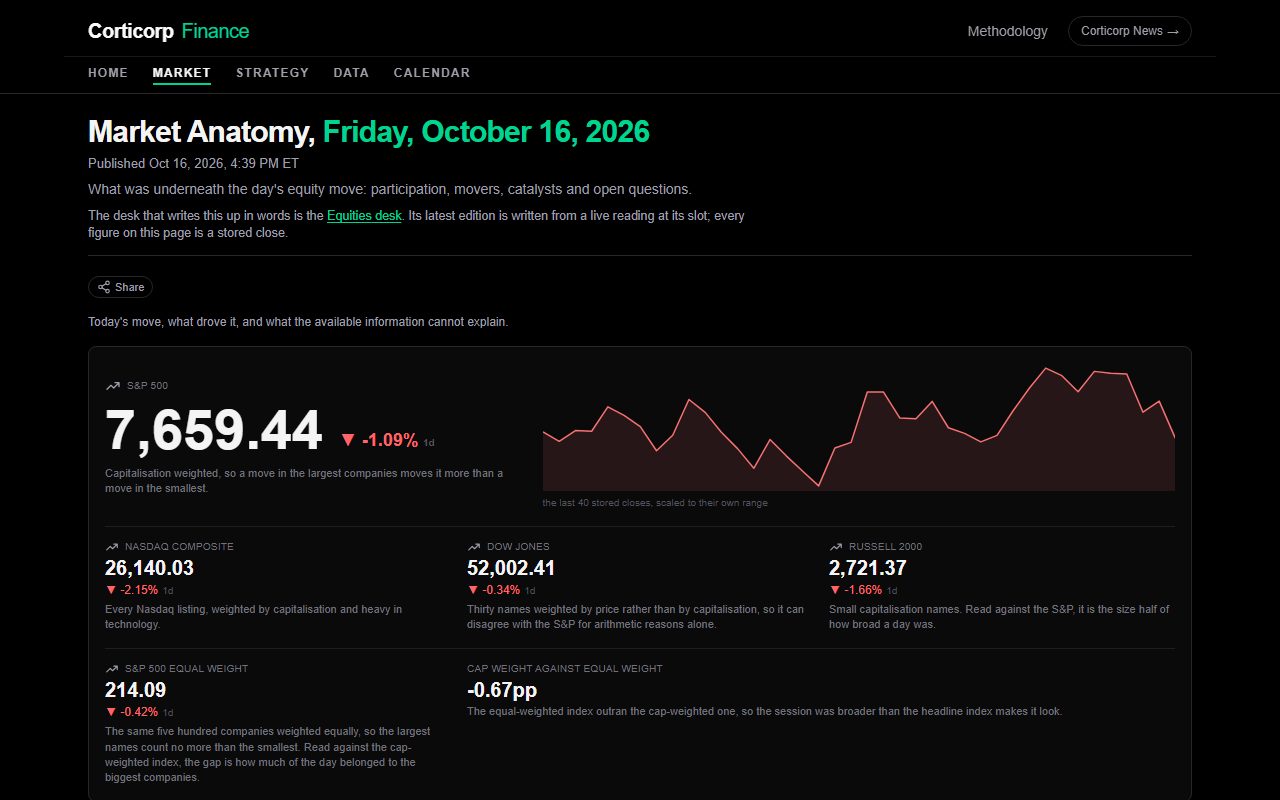
What moved and why, index by index, with a 60-session sparkline on each and the spread between the cap-weighted and equal-weighted S&P 500.
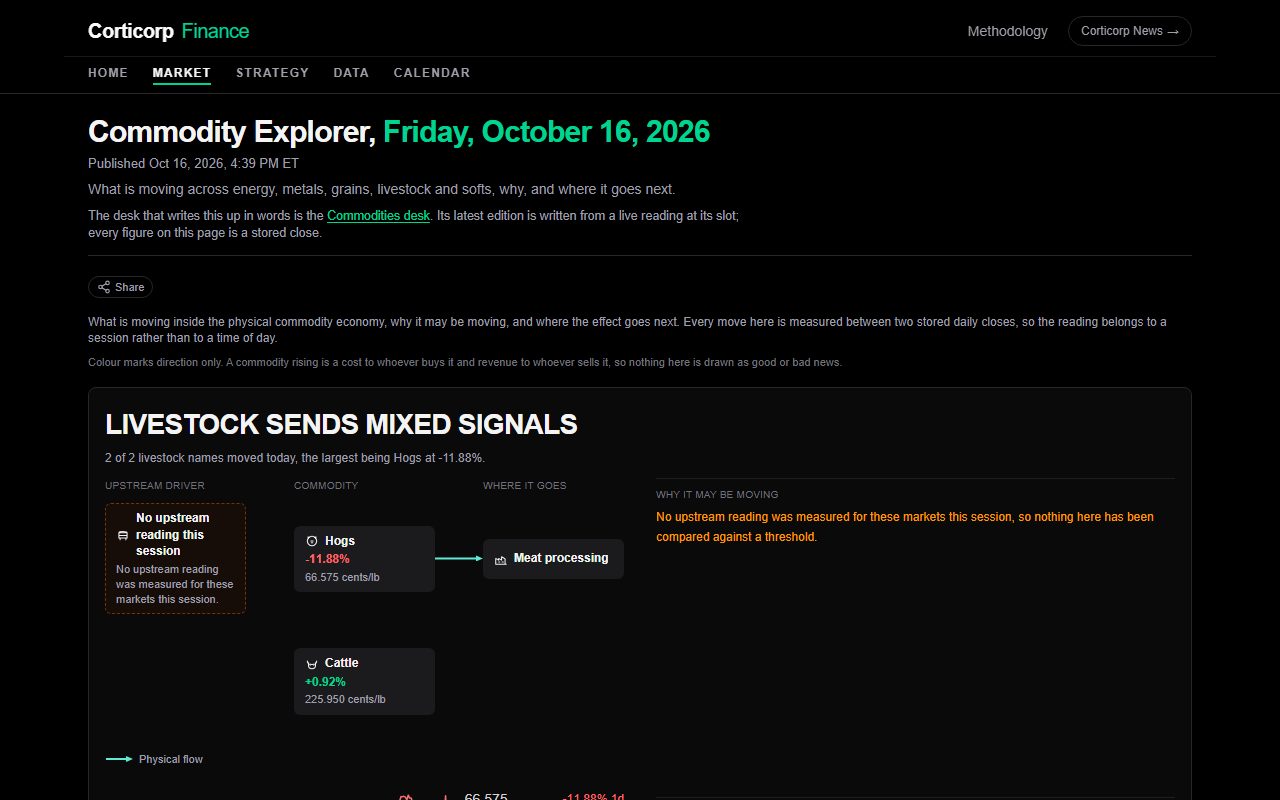
A flow diagram per commodity: the upstream driver, the commodity itself, and where it goes. On October 16, livestock sent mixed signals.
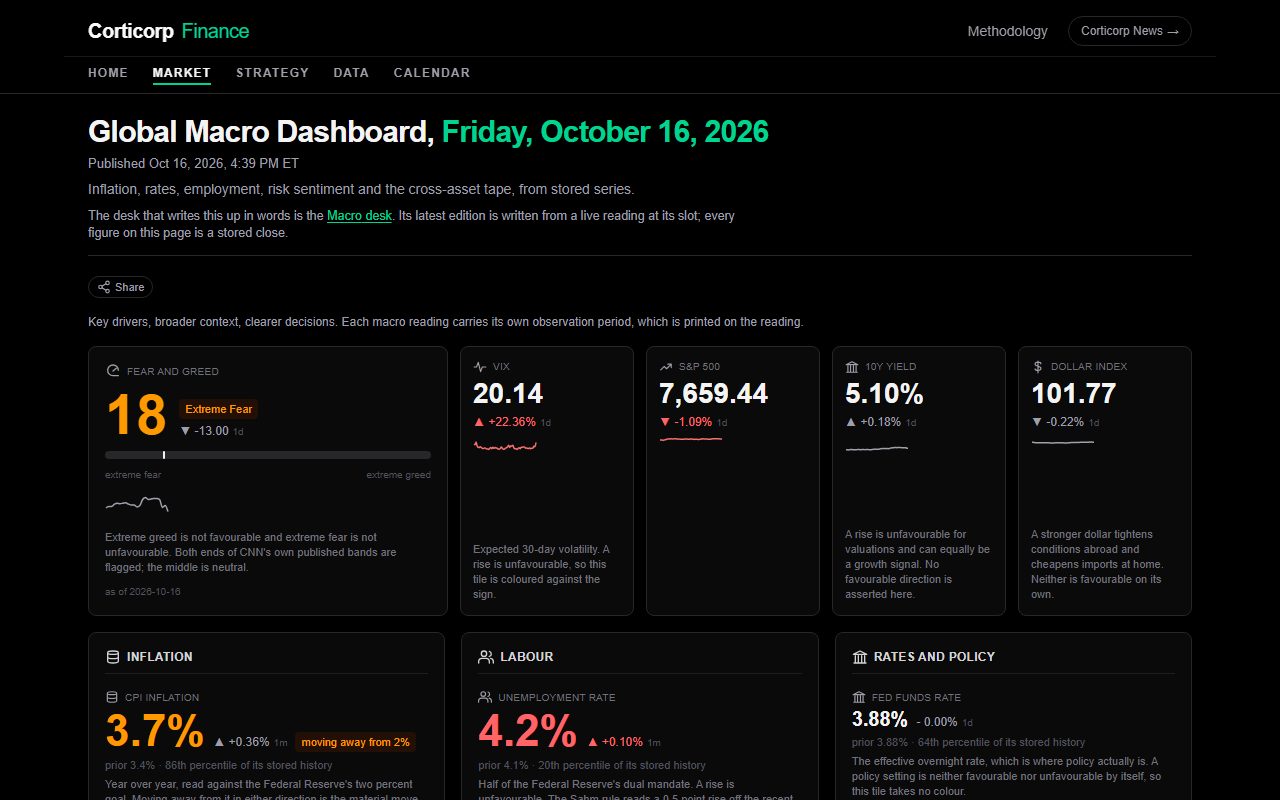
Sentiment, volatility, the 10-year yield, the dollar, inflation, unemployment and the Fed funds rate on one page, dated and kept.
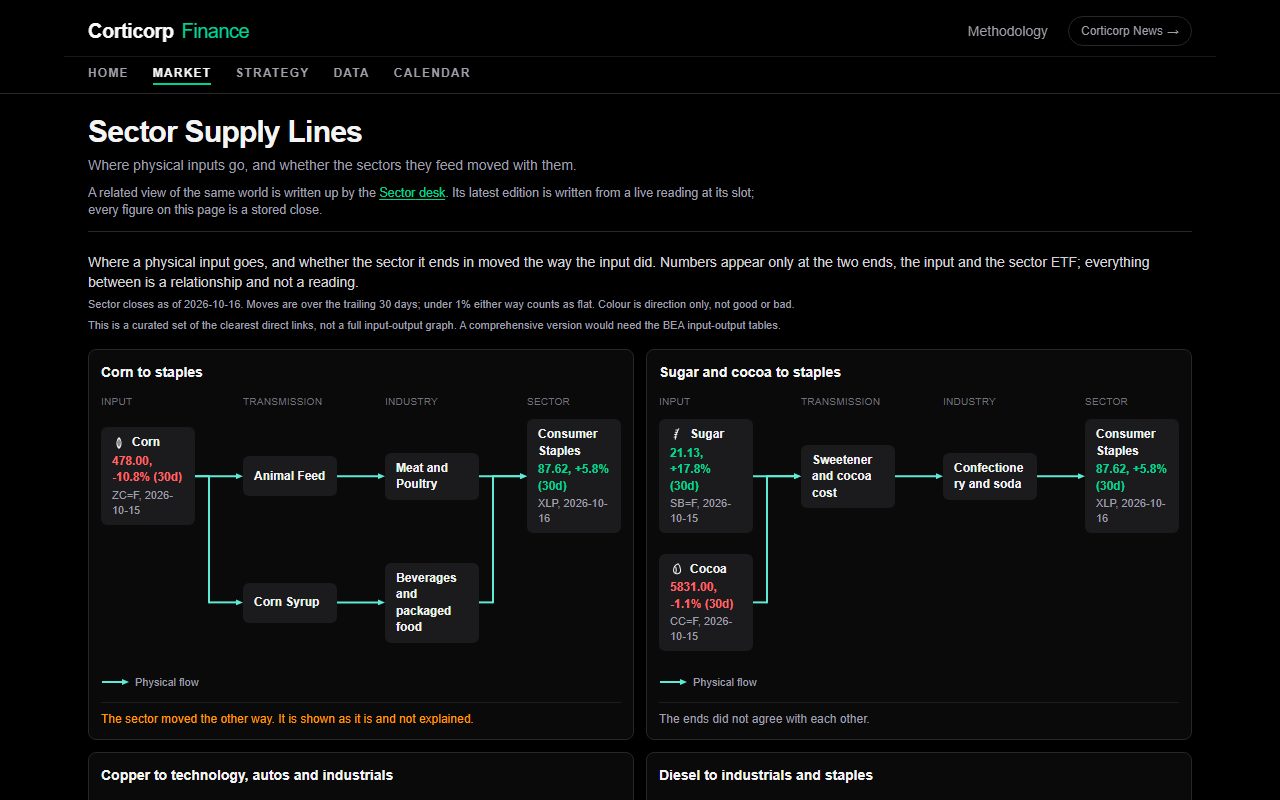
Commodity routes priced end to end with real freight rates: corn to animal feed and beverages to Consumer Staples, sugar and cocoa to confectionery.
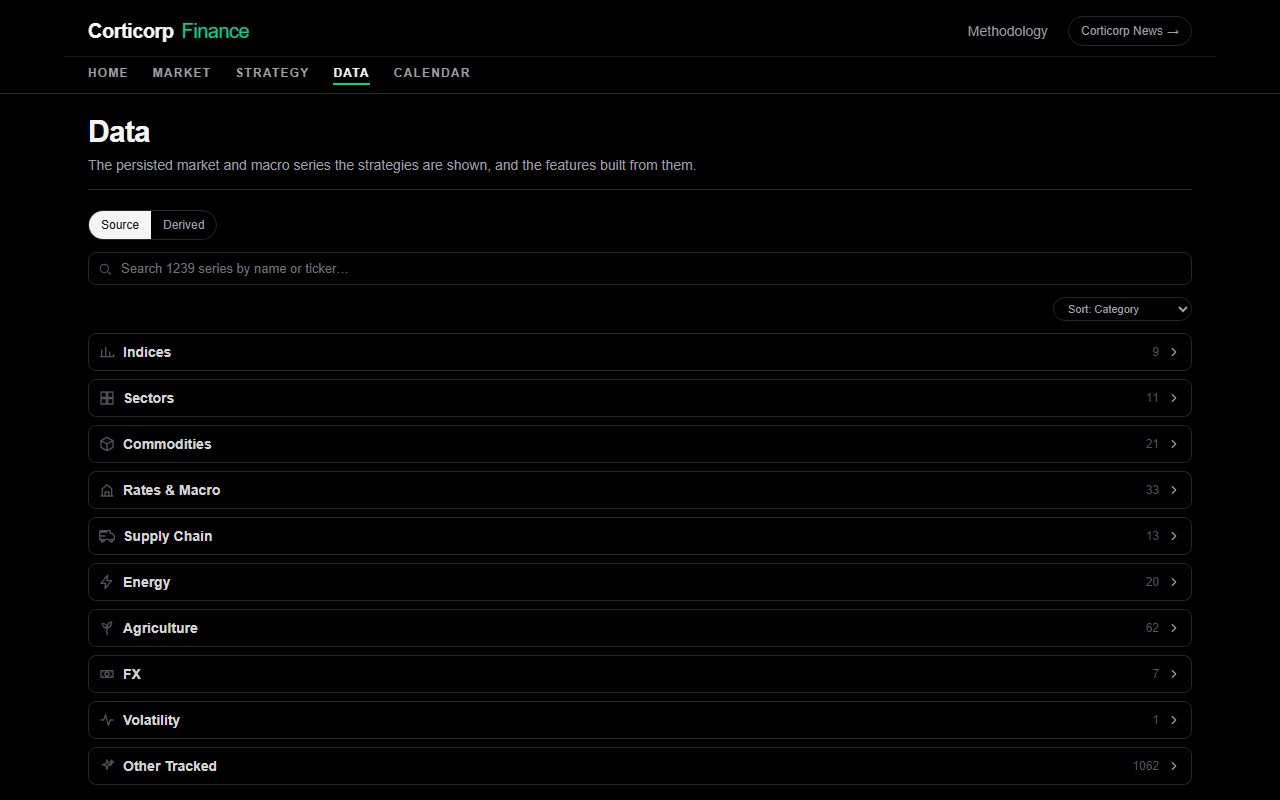
Behind the pages there is far more data than before. Since mid-September the site has taken in ten years of daily prices and fifteen of weather; USDA livestock and freight; CFTC positioning; the Treasury yield curve, eight major currencies and foreign holdings of US securities by country; weekly fund flows; S&P 500 and sector holdings weights; Cboe volatility data; SEC filings as company headlines; and GDELT, to count which outlets carry a story. The Data page was reorganised on October 11 into families of datasets with counts and search, and it now holds 1,239 series.
Every market reading carries a trust label: a stale or unconfirmed number is labelled and withheld from the writers rather than printed as fact. And a feed that stops tries a backup source, fills its own gap and reports what happened.
Finance
Every edition now gets a share card and a drafted LinkedIn post. Since mid-October the card carries a chart that fits what the post says, and the chart is chosen by rule from stored data, never by a model, from more than twenty forms: drawdowns, calendars, rates and FX, volatility, index weights, market breadth, fund flows. The edition page shows the same picture, with a note that it is drawn from the numbers stored with the edition, so what the reader sees on LinkedIn and what they find when they click through are the same chart from the same data.
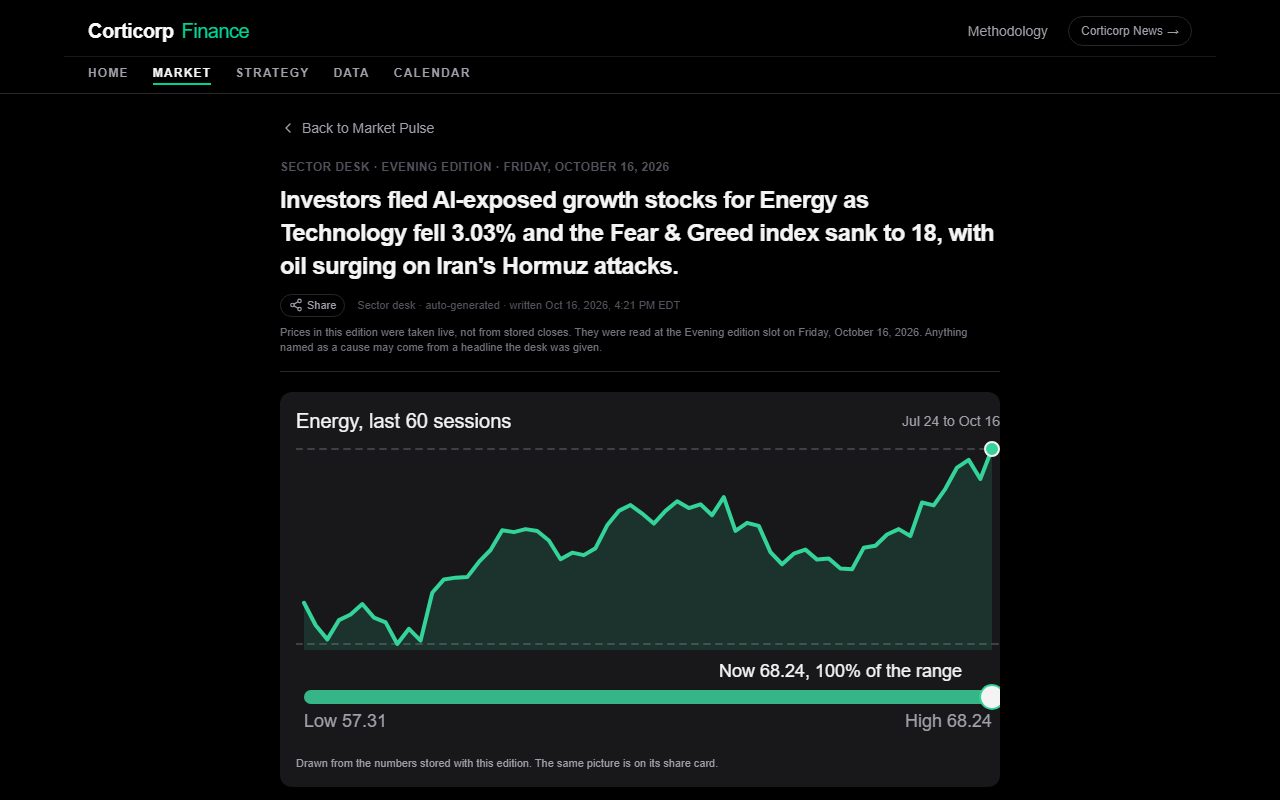
Friday's Sector edition with its Energy chart over the last 60 sessions, drawn from the numbers stored with the edition.
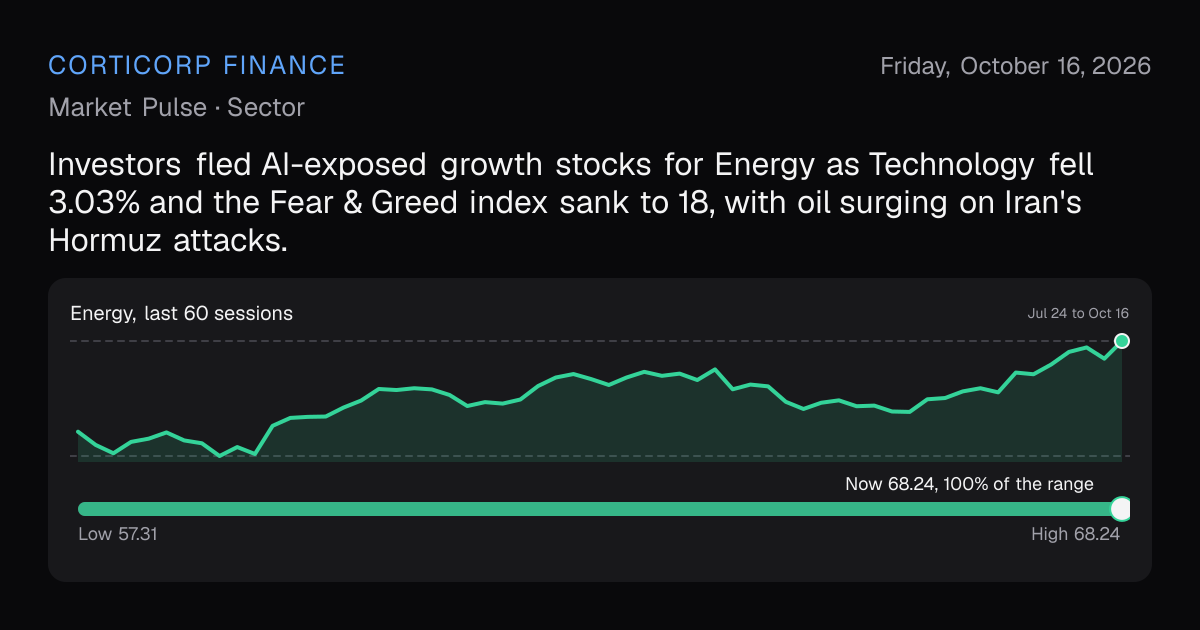
The same chart on the card that travels with the post, with a range bar showing where today sits between the 60-session low and high.
Finance
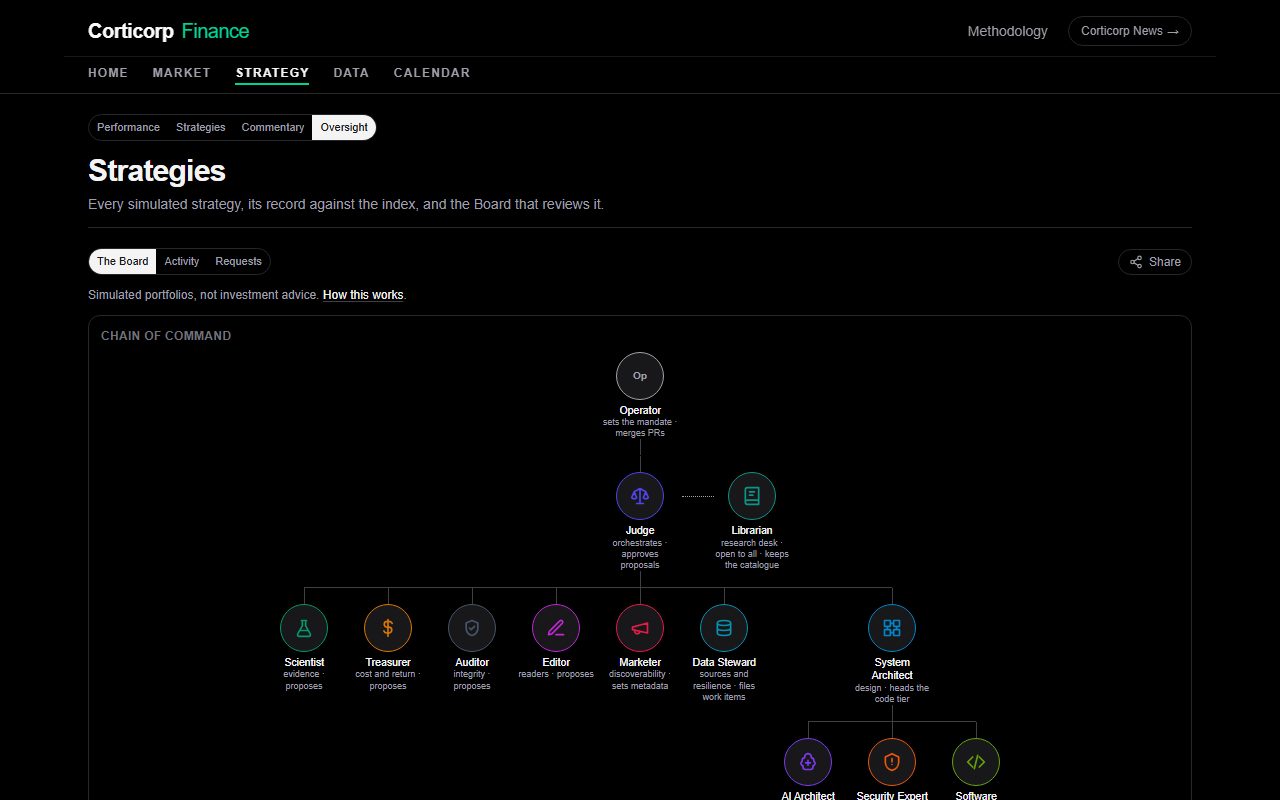
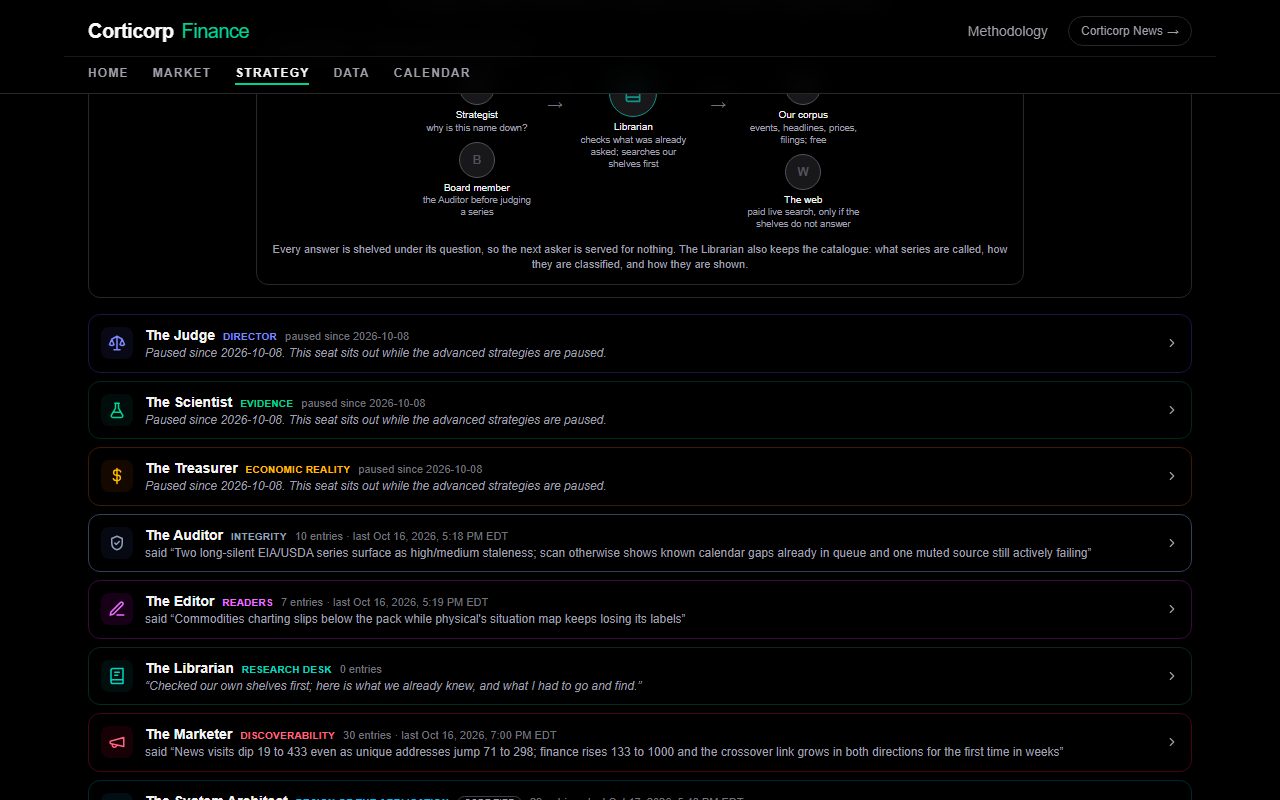
The Board page shows the chain of command and what every member has said or filed. The Judge, the Scientist and the Treasurer have been paused since October 8. The Auditor and the Editor continue. The Librarian, the research desk, now dates its answers and cites its sources, with a spot-check on what it says. The Marketer files a weekly readership report on Friday at 7pm ET and drafts the LinkedIn posts. The Data Steward joined on October 10 to find free sources and watch over the resilience of what the site holds.
Five roles never run inside the site at all. The System Architect, the AI Architect, the Security Expert, the Data Steward and the Software Engineer read the repository, and only the Data Steward has access to the web. Their findings are sorted into a deduplicated public work queue, so the site's to-do list is a page anyone can read.
New project

The Open Page Document, or opd, is an open document format meant to replace PDF in the common case: showing a fixed, formatted document without the weight of the PDF toolchain. One .opd file is one zip. Inside it is a clean, reflowable source in a strict subset of HTML and CSS, with no scripting and nothing loaded from outside the file; optionally a frozen copy of the exact pages, one SVG per page, for print and archive, bound to the source by hash; fonts as WOFF2; images; metadata; and a manifest listing every entry with its SHA-256.
The gap it fills is a specific one. Nobody ships a single file carrying a validated reflowable source and a frozen page render bound to it by hash, under a signature that survives later user data. The format is honest about determinism: the source promises a stable structure, pixel fidelity is claimed only for the frozen pages, and if the two disagree the reader is told. The tools never quietly pick one.
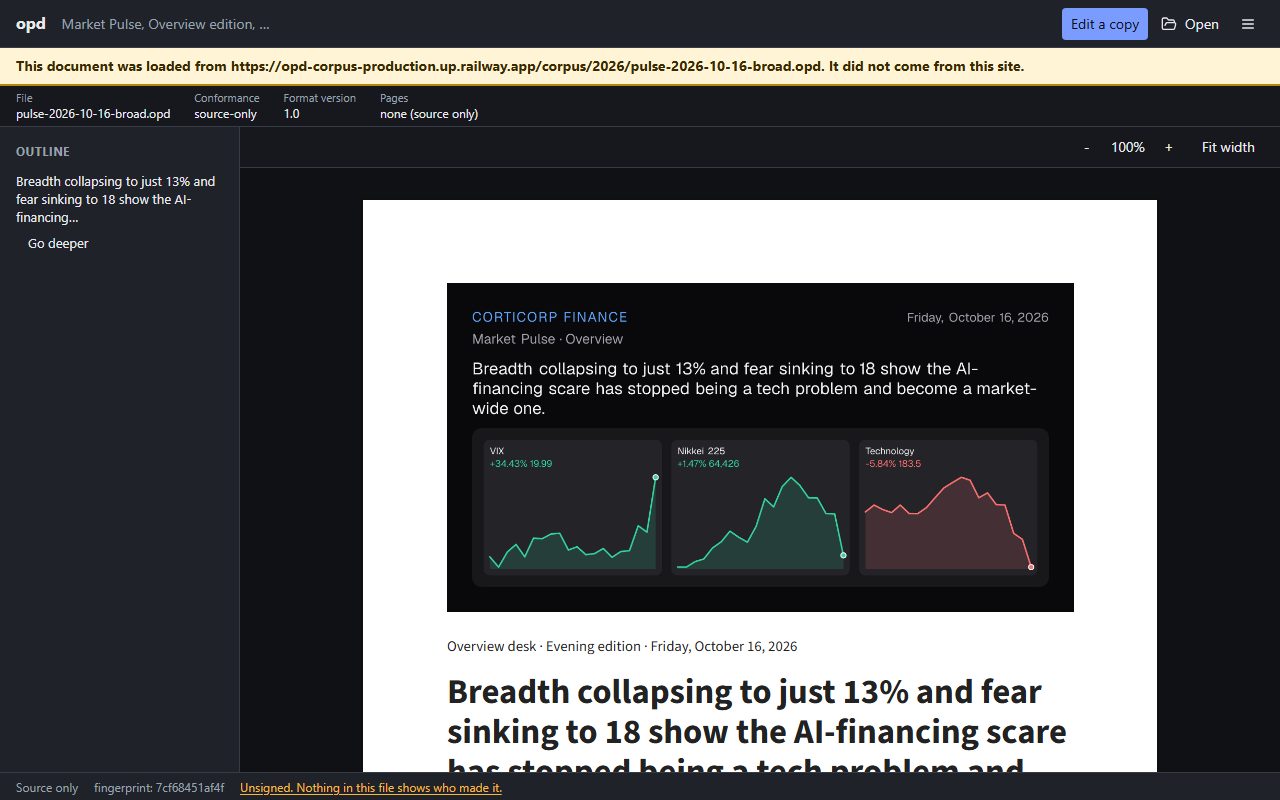
A real Market Pulse edition opened by link, with a provenance bar that says where the file came from.
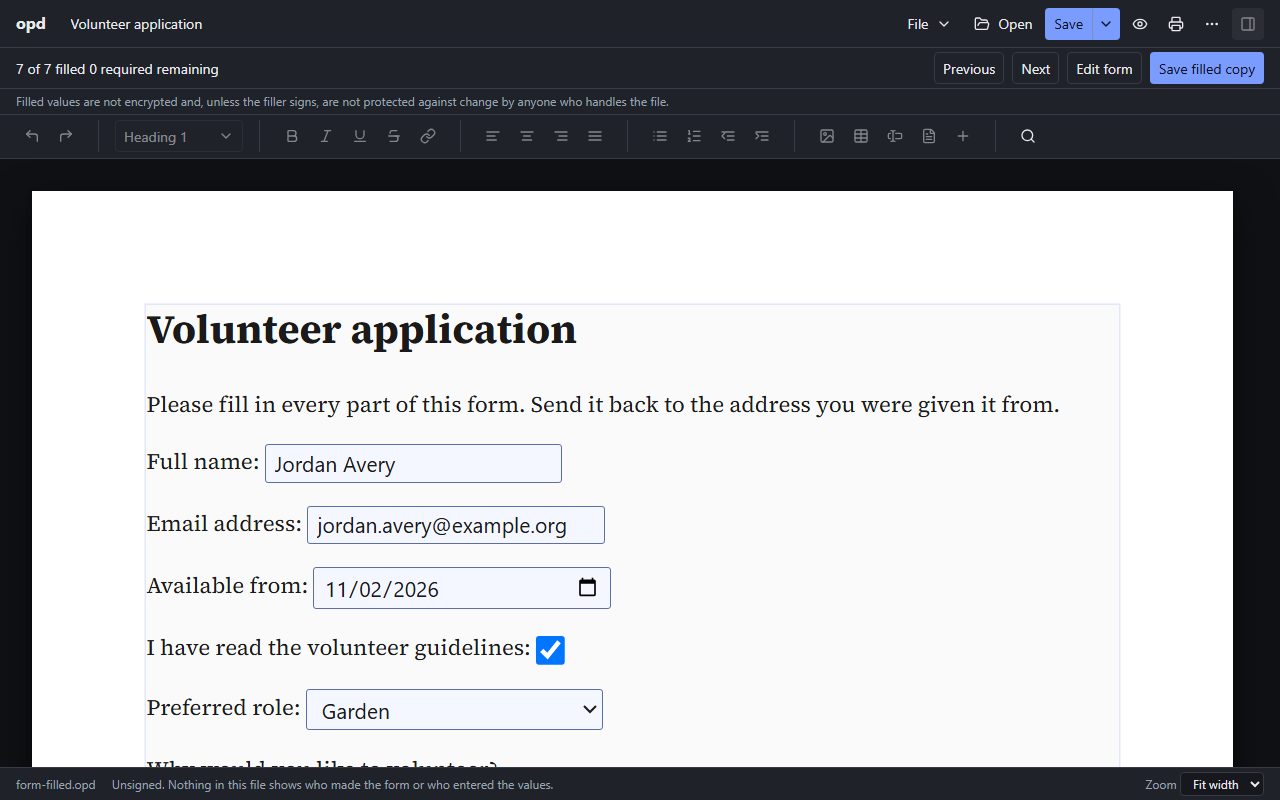
A form opens ready to fill inside the editor. Edit form warns that it makes a new version; Save filled copy keeps the author's bytes unchanged.
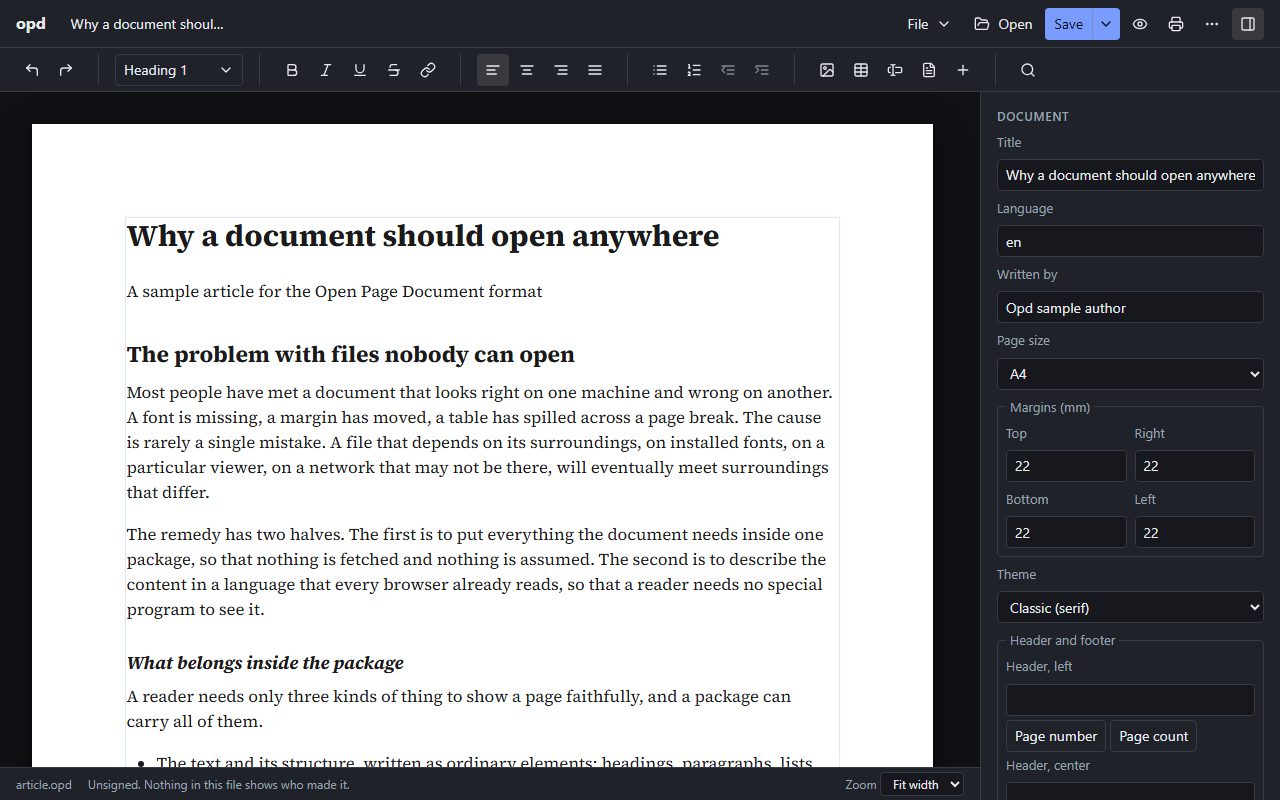
One standard toolbar and a Document panel for the page size, margins, theme, header and footer.
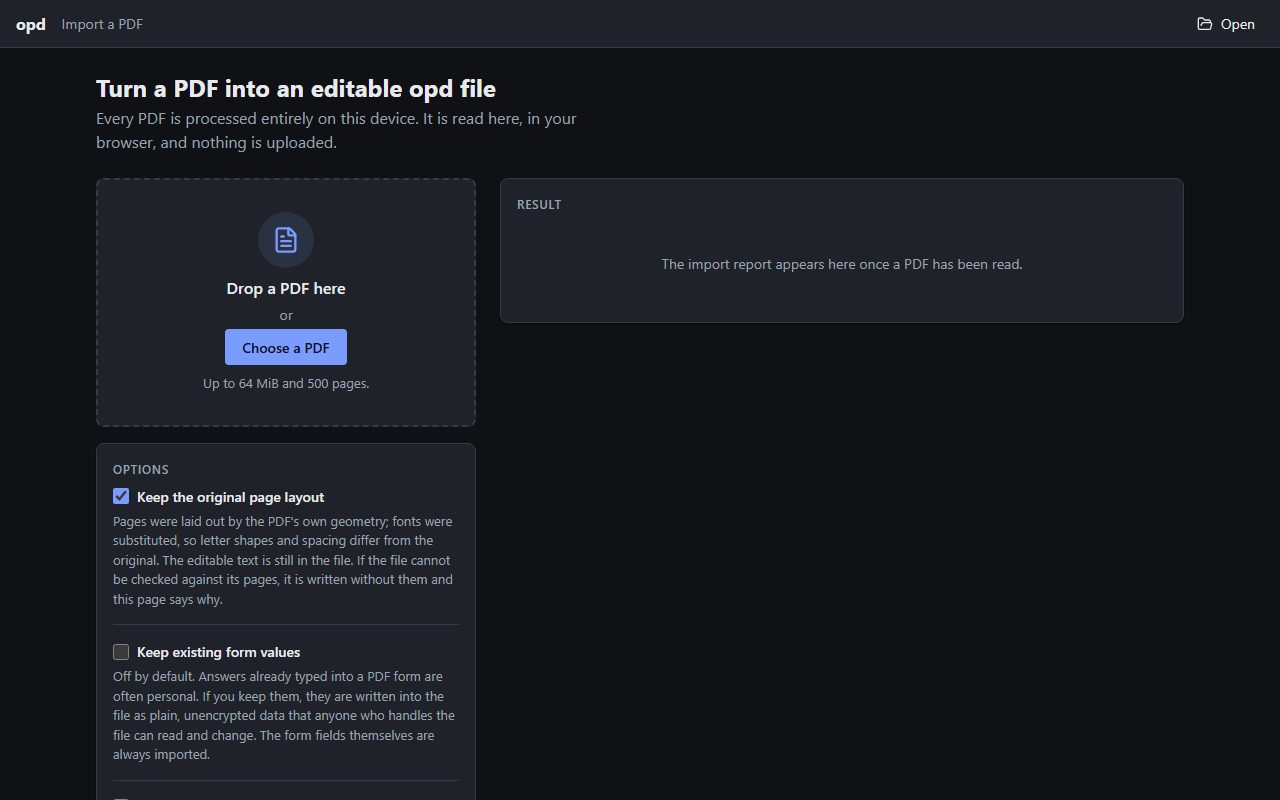
Every PDF is processed entirely on the device, with the option to keep the original page layout.
No modes. Since October 18 every valid file opens editable with one standard toolbar, and a form opens ready to fill inside the editor; Edit form warns that it makes a new version. The editor can only produce valid files, because its schema is generated from the format's own profile. It handles tables, footnotes, a table of contents, headers, footers, page numbers, and custom and landscape page sizes.
Create, send, fill, return. Form fields are declared separately from the text. Filling writes the answers to a user-data area and leaves the author's bytes unchanged, and a form fingerprint shows that the form came back unaltered. A Collect view groups the returned copies and exports a CSV on the device. Authors and fillers can sign with Ed25519 keys, and the wording is careful: a signature proves that the holder of this key signed exactly these entries, and it does not identify the holder. The tools never say "verified".
PDF import. The importer keeps text, structure and AcroForm fields, and can redraw the original page layout from the PDF's own geometry; fonts are swapped for open-licence fonts, never embedded from the PDF. On a 35-document ground-truth set scored on October 19 it reaches a block F1 of about 0.97, a reading order of 1.00, exact text of 0.988 and 9 of 10 tables, at about 23 milliseconds per page. Form field recall is 0.58, because forms without AcroForm fields are missed. Slide decks import slide by slide. An optional "Improve structure with AI" step uses your own Anthropic key in the browser only, and it is reported as it measured: no gain on the ground truth.
Three files that work anywhere. The viewer (about 0.5 MB), the editor (about 1.3 MB) and the PDF import page (about 2.2 MB) are each a single HTML file that runs offline from any folder, tested to make zero network requests. The hosted app can register itself to open .opd files. Documents render in a fully sandboxed frame with no scripts under a strict content security policy; the site sets no cookies and has no server code. Every Corticorp Finance Market Pulse edition is re-exported to .opd every six hours and served with open CORS, which is how the viewer above opened one by link.
How it was built. In four days, October 16 to 19, 2026, in about 101 commits and 55 pull requests, by a Board of Claude Code subagents: a System Architect, an AI Architect, a Security Expert and a Software Engineer. Only the Engineer writes code, in branches with pull requests, and a hook blocks it from merging. The result carries more than 1,000 unit tests, Playwright runs in Chromium, Firefox and WebKit, and accessibility checks at zero findings. The spec is CC BY 4.0 and the code is MIT; the repository is private for now, and the project is an experiment that may or may not continue. Still open: carrying a file's own stylesheet through edits, multi-column layout, the remaining spec chapters, a second implementation, and scanned-PDF import.
Elsewhere
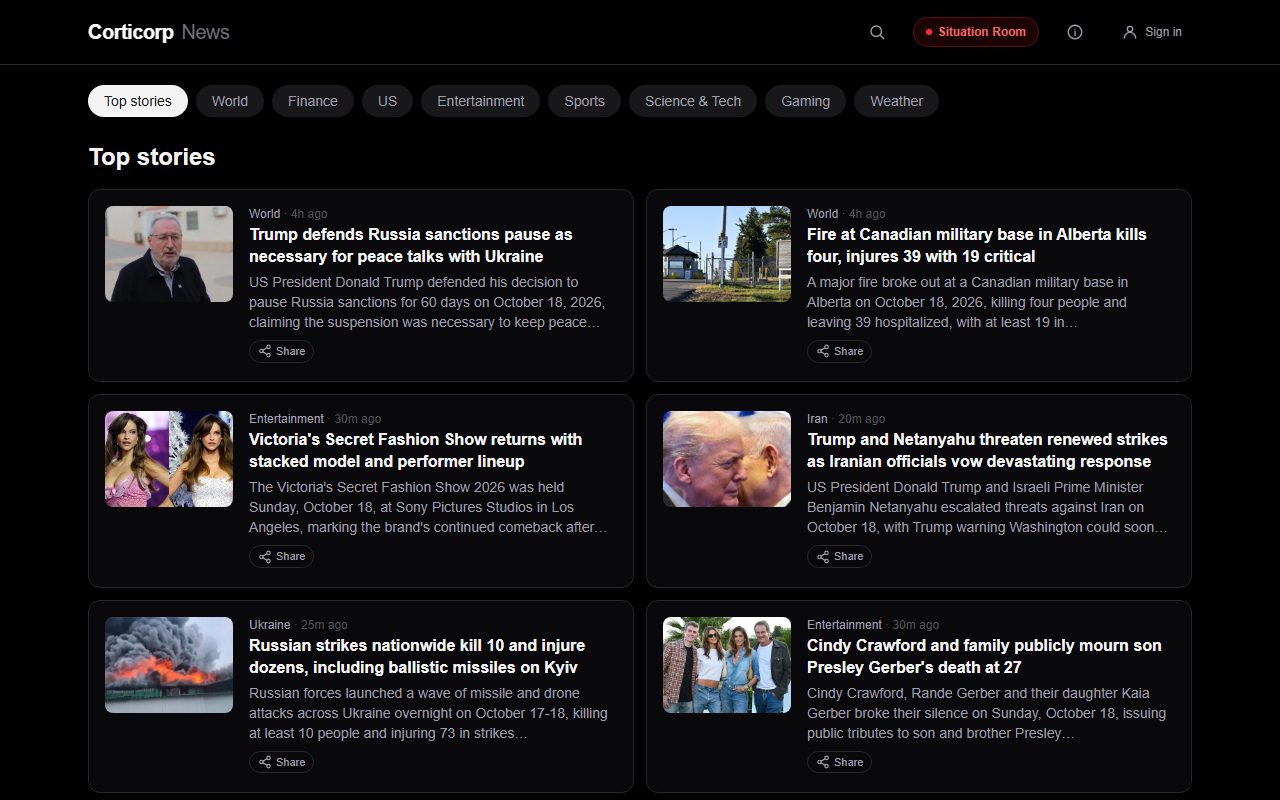
Top stories is the home page since October 17: sixteen slots, five of them kept for the lighter sections, with duplicates removed. Every story and every section now has a preview card and a written share line, the three Situation Rooms for Ukraine, Israel-Palestine and Iran got a Share control and a map card, and the Share button opens the device's own share sheet. New sources include DW, France 24, PBS, UN News, official finance releases and dedicated feeds per conflict theatre; feeds whose terms bar this use were dropped, and a merged story redirects to the one that survived.
The map has grown from about 34,700 cameras to around 53,000 worldwide, from traffic authorities, observatories and weather networks on five continents. About 18,000 of them came on October 4 from thirteen new key-free sources, among them New York, Spain, Washington, Ohio, Oregon, Illinois, Michigan, Iceland, the Australian states and NOAA's ocean buoys, plus WeatherSTEM's Florida sky cameras, South Africa's SANRAL, and Windy for every country it offers. Thirty-seven hand-picked remote cameras fill the emptiest regions: Hanle observatory in Ladakh, Halley in Antarctica, Bird Island, Sutherland, Izana and two Maldives atolls among them. A shared link to a map view or a single camera now shows a preview of the satellite view with live frames on it, and the open camera is kept in the address.
Less visible, and worth having: health checks and safe rollbacks on every Finance deploy, tests on every change, a nightly off-site backup, and a round of security upgrades. A market feed that stops now tries a backup source, fills its own gap and reports what happened, and a stale number is labelled and withheld rather than written up as fact.
One more thing: a Tagalog to English translator is built and coming soon. Details.
Four live sites, one of them four days old. Finance keeps a dated diary of what has improved and when.