Coming soon
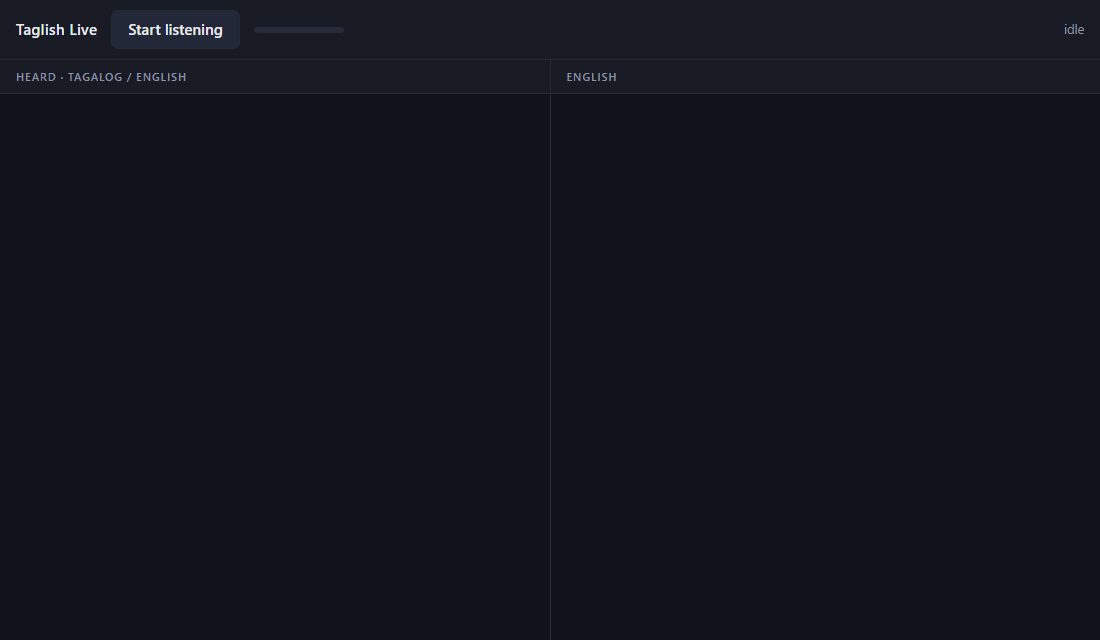
Real-time transcription of Tagalog and Taglish, the everyday mix of Tagalog and English, with an English translation a beat behind. Open the page, press Start listening, and talk: one column shows what was heard in whatever mix it was spoken, the other shows it in English. It listens continuously rather than turn by turn, so a conversation reads like a conversation.
The software is built and, in theory, ready to use. It has not had its first trial on real speech yet. That trial comes first, with a native speaker of Tagalog and Bisaya, before anyone else is asked to rely on it.
How it works
Taglish switches between Tagalog and English mid-sentence. The recogniser and the translator are both told that this is ordinary speech, not an error, so a mixed sentence is transcribed as spoken and translated whole.
The browser streams the microphone to the server. A voice-activity detector finds where speech starts and stops, partial text refreshes as you talk, and each finished line is translated with the few lines before it for context.
Nothing is sent for recognition or translation while nobody is speaking, so leaving it open in a quiet room is free.
Bisaya, or Cebuano, is a hoped-for extra rather than a promise. The prompts allow for it, and the first trials will say whether the speech models actually handle it.
Two ways to run it
Speech recognition runs on a local graphics card with an open model, Qwen3-ASR, with Whisper as a fallback. Only the translation goes to a hosted open model, which keeps the running cost to roughly five cents an hour of talk.
A small container with no GPU: recognition goes to a hosted speech service that lists Filipino and Cebuano, translation to a hosted model. Anyone with the link and an access code can use it from a phone, at roughly forty-five to ninety cents an hour of talk.
A shared access code, a cap on concurrent sessions and on session length, and one usage line per session recording the audio sent and the translation tokens, so the real cost per hour is measured rather than guessed.
A comparison tool runs the same recording through every speech backend along the same streaming path the live server uses, so the provider is chosen on real Filipino speech rather than on a vendor's language list.
Status
The server, the listening page, both run modes, the comparison tool and the deployment files are written.
Real recordings in Tagalog, in Bisaya and mixed, from a native speaker, judged separately from noisy film audio used as a stress test.
Once the trials hold up, a link to try it appears here and in the updates.