One file, one zip
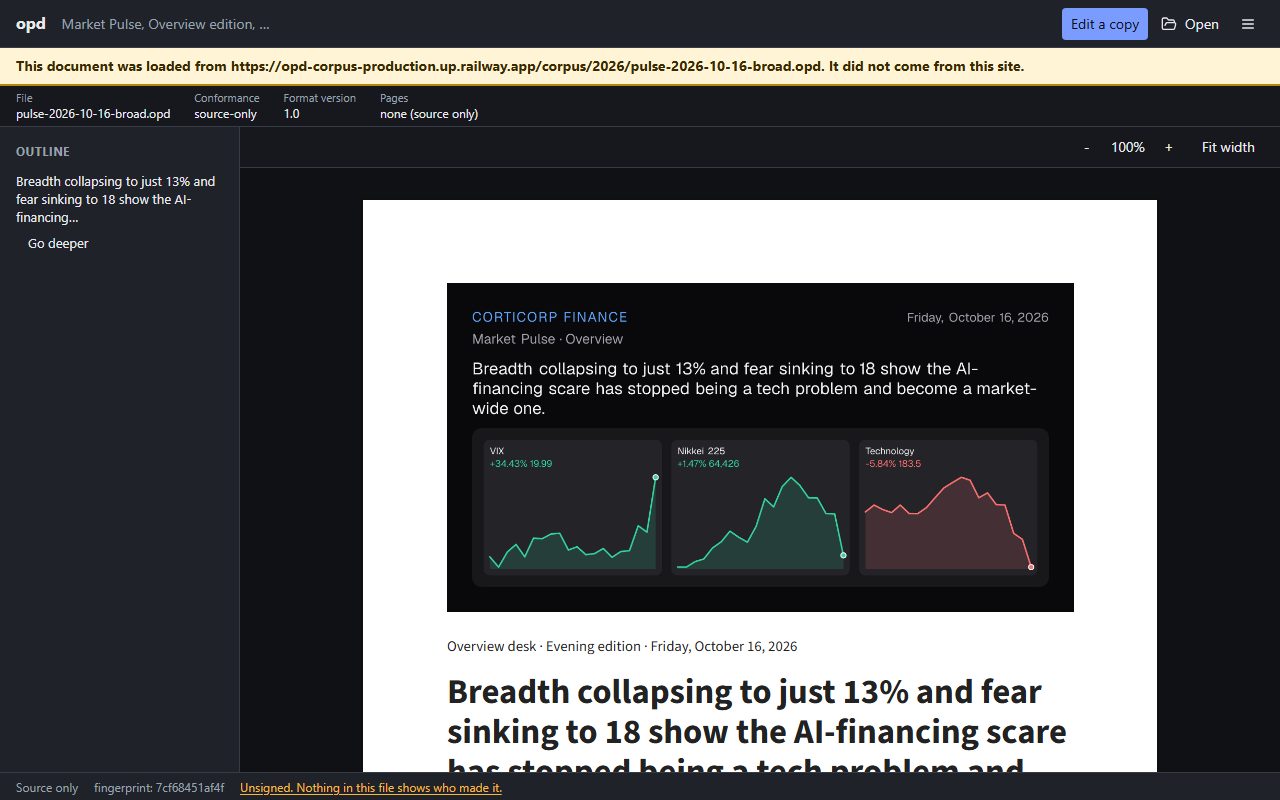
Source, frozen pages, fonts, images, metadata and a manifest with a SHA-256 for every
entry, all in a single .opd file with the media type application/vnd.opd+zip. Nothing is
fetched from outside the file and nothing in it can run a script.
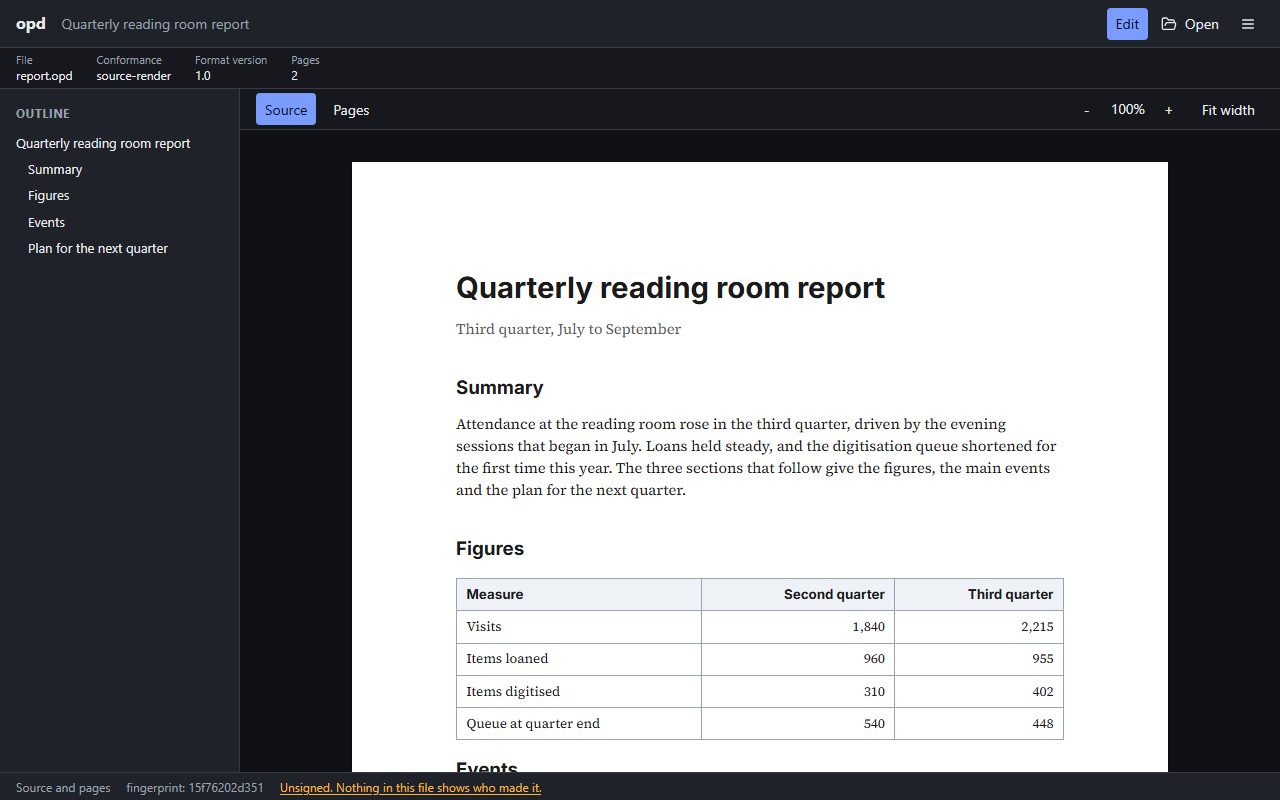
A source that reflows, pages that are frozen
The source is a strict subset of HTML and CSS, so it fits any screen. The optional frozen
pages are one SVG each, for print and archive, and they are bound to the source by hash so
a reader can tell the two belong together.
Honest determinism
The source promises a stable structure. Pixel fidelity is claimed only for the frozen
pages. If the two disagree the reader is told, and the tools never quietly pick one.
No modes
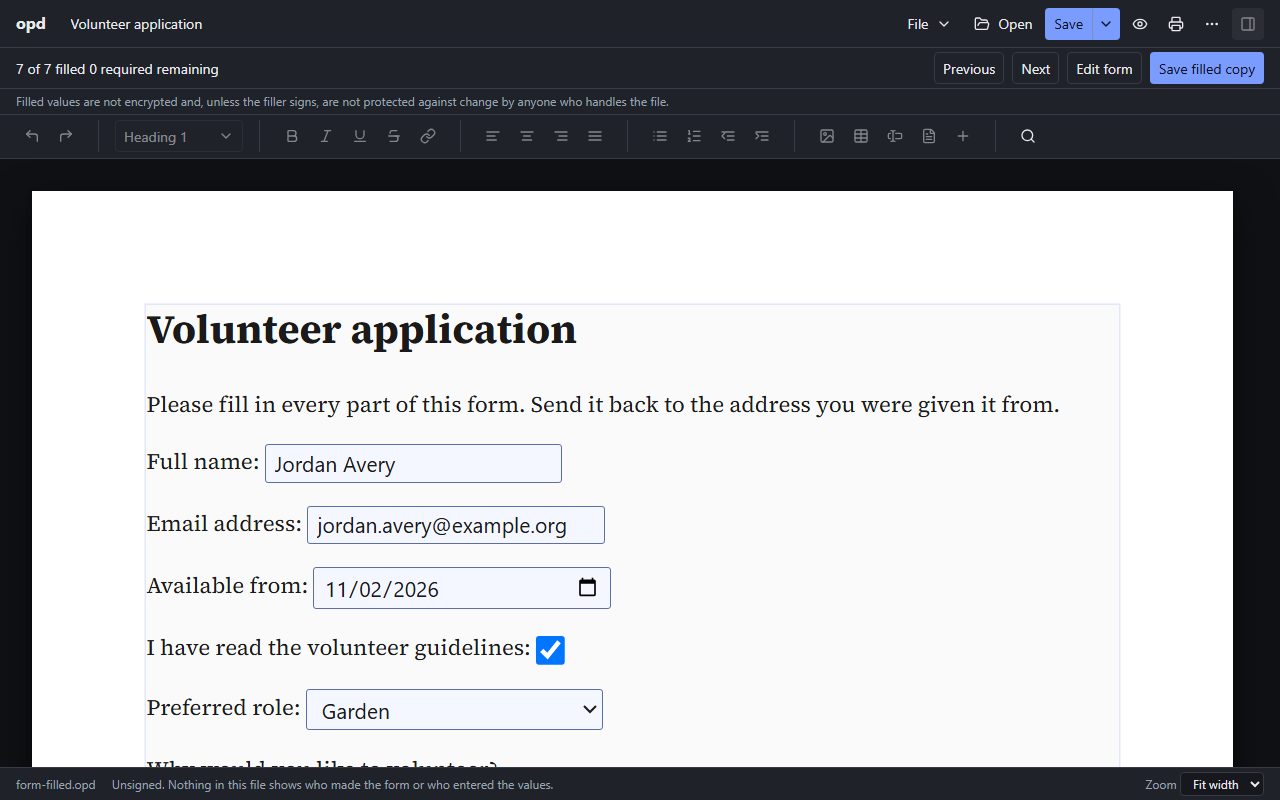
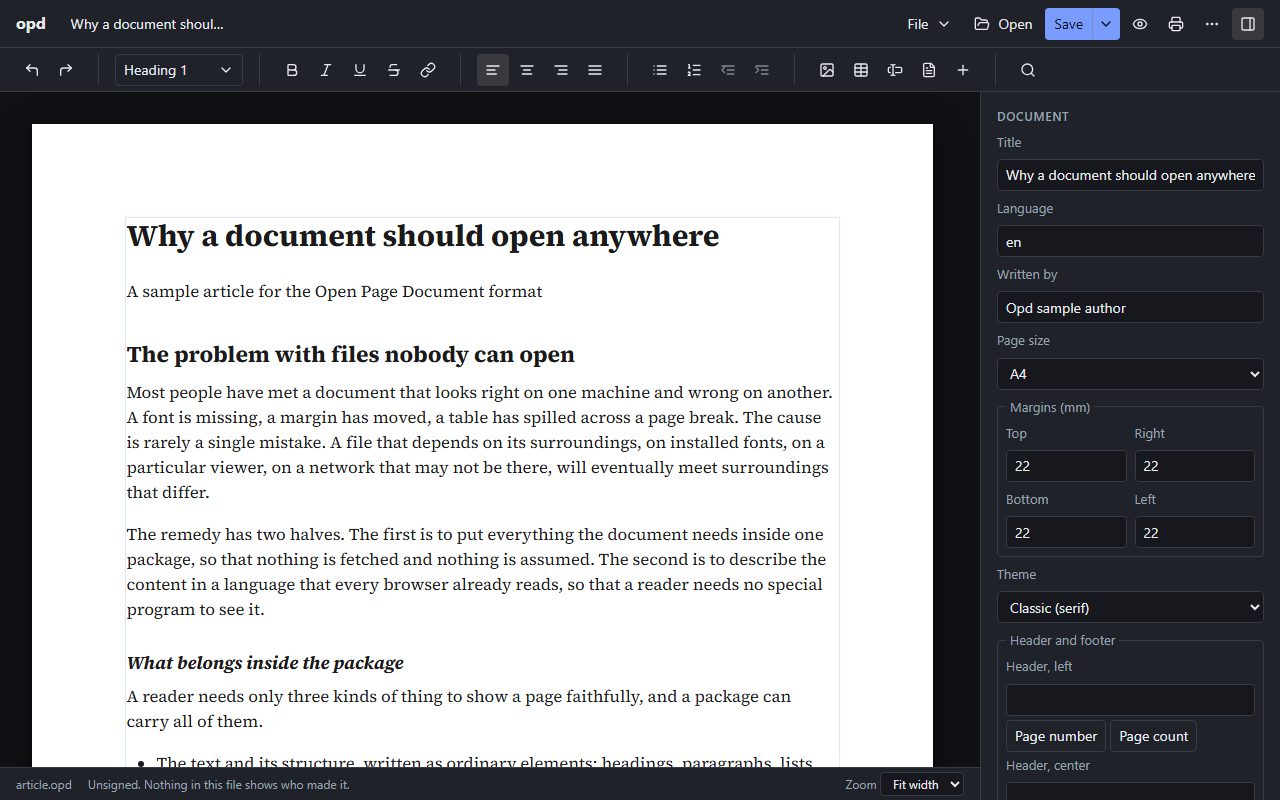
Every valid file opens editable with one standard toolbar. A form opens ready to fill
inside the editor, and Edit form warns that it makes a new version. The editor can only
produce valid files, because its schema is generated from the profile.
Create, send, fill, return
Form fields are declared separately from the text. Filling writes answers to a userdata
area and leaves the author’s bytes unchanged, a form fingerprint shows the form came
back unaltered, and a Collect view groups returned copies and exports CSV on the device.
Signatures with honest wording
Ed25519 signatures for the author and the filler. The wording is careful: a signature
proves the holder of this key signed exactly these entries; it does not identify the
holder. The tools never say “verified”.
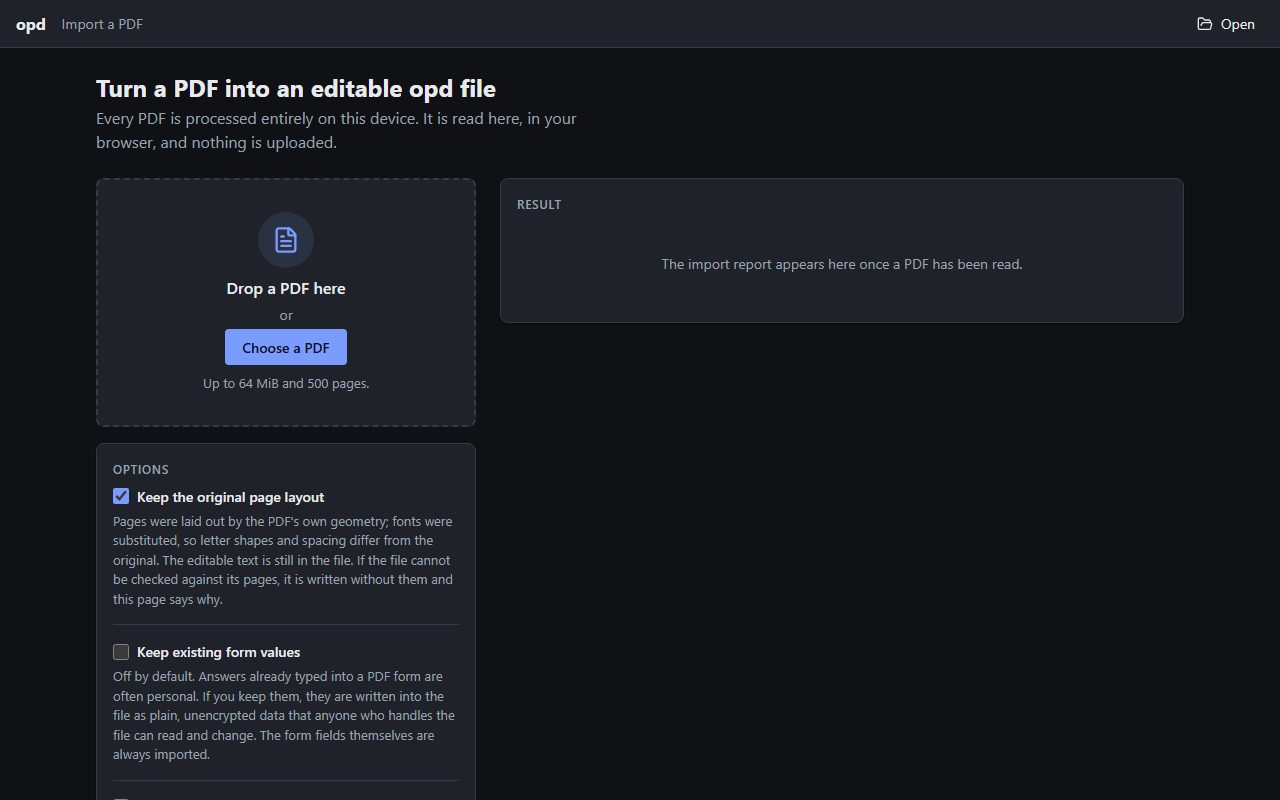
PDF import that keeps the look, with its scores on the table
Import keeps text, structure and AcroForm fields, and now the look as well: text colours,
slide backgrounds, rules, card grids and column regions, and up to 40 named styles. Fonts
the PDF names are matched to a pinned set of open-licence faces, never embedded from the
PDF, and photos stay JPEG. On a 40-document ground-truth set: block F1 0.973, reading
order 1.00, grids 5 of 5, tables 10 of 11, style match 0.98, form field recall 0.58.
Export to PDF, for everyone not on opd yet
Any document exports to a real PDF from the viewer, the editor or the command line, built
from opd’s own page layout: selectable text in the document’s fonts, clickable
links, accessibility tags, charts as vector shapes, and form fields that stay fillable
with their answers. The PDF carries no scripts, and it says plainly that it does not
carry the opd signature.
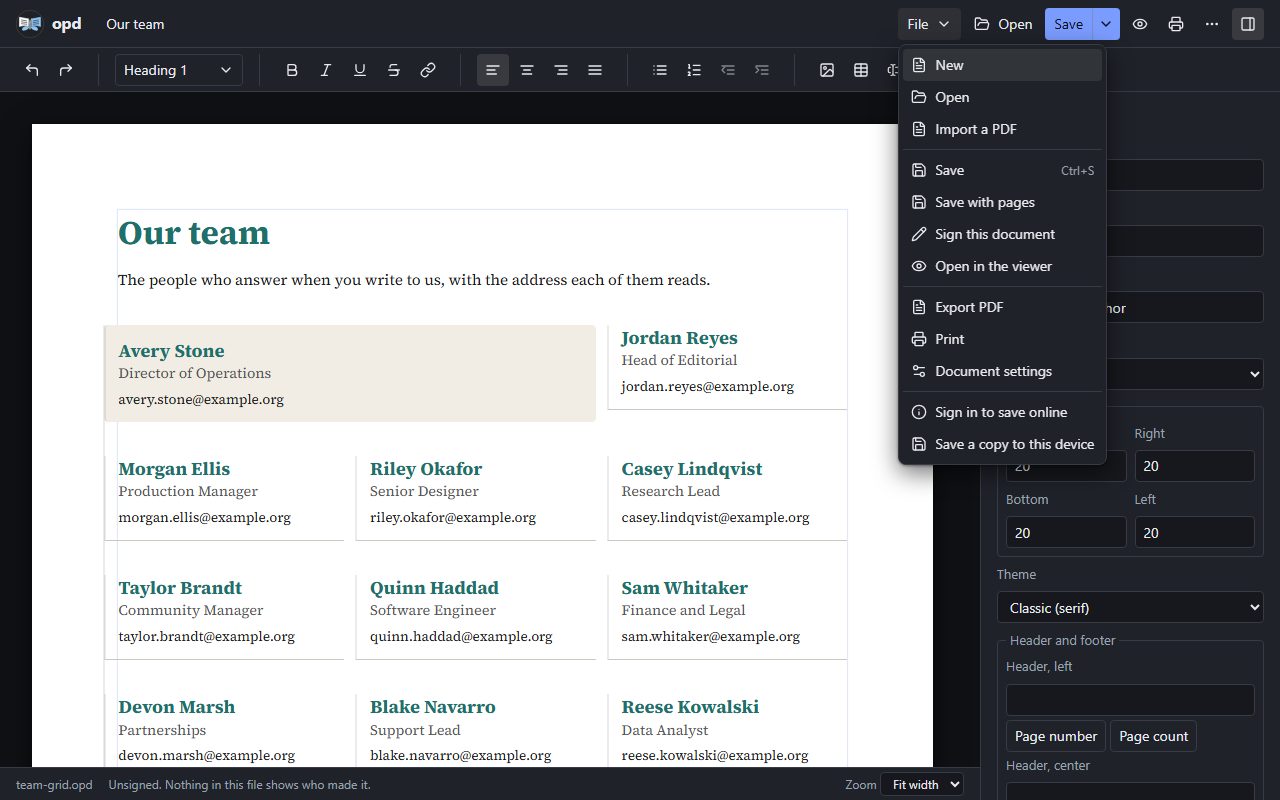
Grids and named styles
Format 1.2 adds card grids, gaps and rounded corners, and named paragraph and character
styles. The editor keeps a file’s own stylesheet and fonts through every save, edits
a style once for every place it is used, and inserts and reshapes grids. Visual order
always matches reading order, by design.
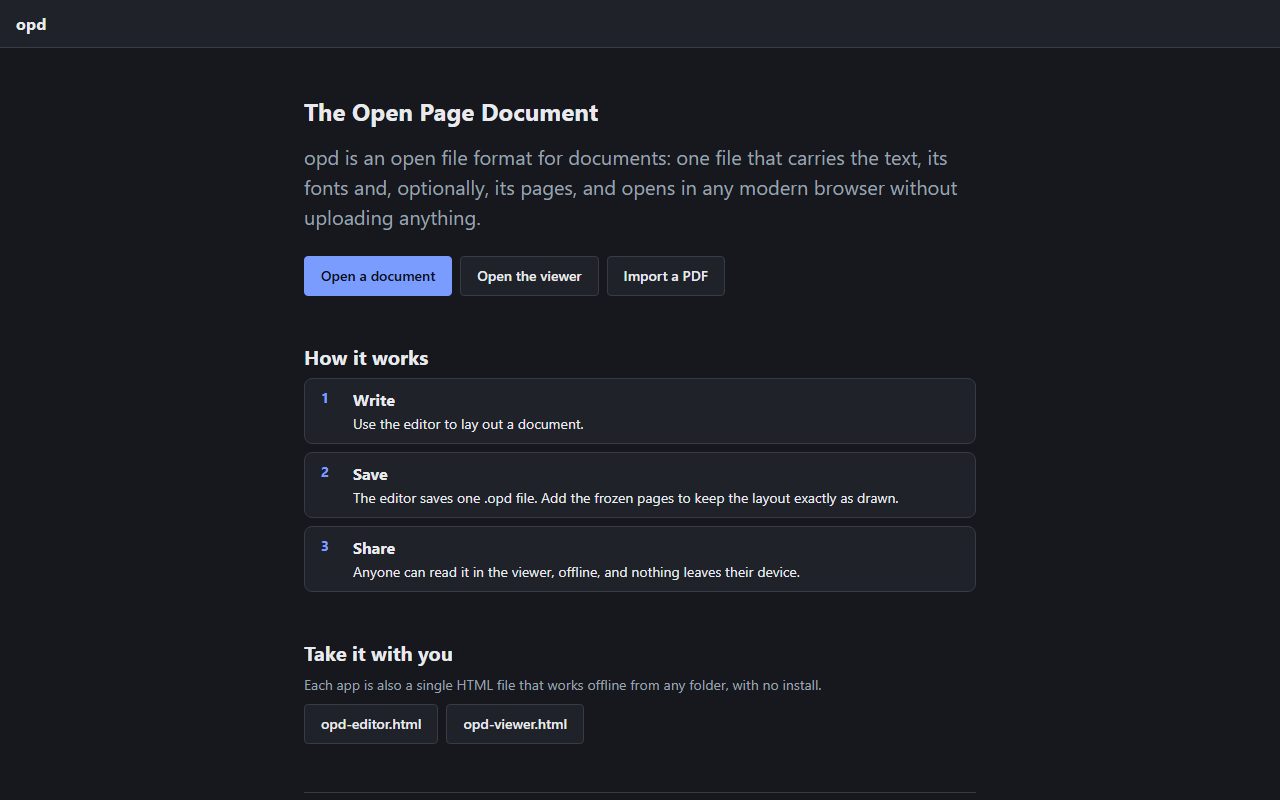
Single files that work offline, and a sandbox
The viewer (about 0.75 MB, PDF export included), the editor (about 1.6 MB) and the PDF
import page (about 2.4 MB) are each one HTML file that runs from any folder, tested to make
zero network requests. Documents render in a fully sandboxed frame with no scripts under a
strict content security policy. On the hosted site, an optional passkey sign-in keeps
documents online; registration is closed while it is tested.