Live web app
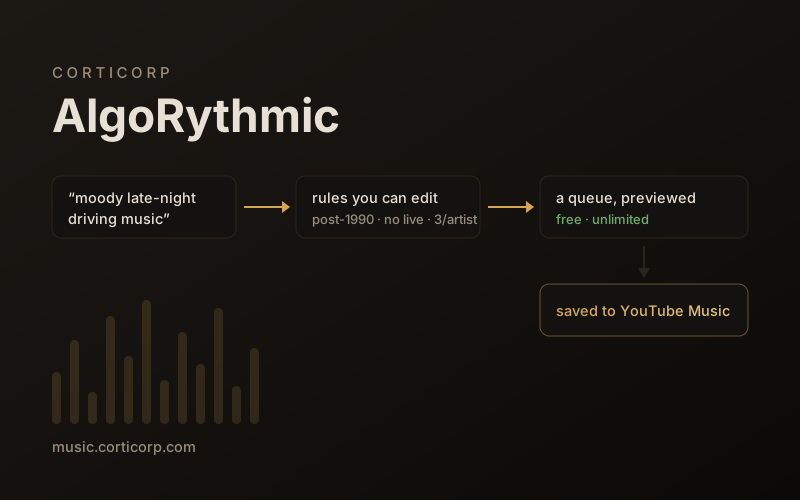
A playlist builder for YouTube Music that treats a playlist as a rule set you can edit rather than a black box. Describe a vibe in plain English and it compiles to selection rules you can actually see and change: era, length, no live versions, never the same artist twice. Or start from one song and weight what "similar" is allowed to mean, across eight dimensions. Preview the whole queue in the browser for nothing, then save it once as a real private playlist your car can play.
How it works
A sentence compiles into a visible strategy: filters, ordering, and limits you can open up and adjust. If the queue is wrong, you can see which rule made it wrong.
Give it a track and weight eight dimensions of similarity yourself: same artist, same era, same country, similar mood and so on. "Similar" stops being somebody else's definition.
Your YouTube library syncs into a local database once, and every strategy runs against that mirror. Generating and previewing are deterministic, instant, and cost nothing.
Tracks pick up factual detail from MusicBrainz and a written sense of feel from a language model, so a rule about era or mood has something real to filter on.
Paginated discovery searches out past what you already own, and can name the artists that make up a scene rather than making you list them yourself.
Saving writes a genuine private playlist on your YouTube account, so it plays in the YouTube Music app with background playback, lock-screen controls and Bluetooth metadata. Confirmed working in a car.
The constraint
The YouTube Data API gives a project 10,000 quota units a day, and writes are what hurt. That one number shapes the whole product: everything that can be done against the local mirror is free and unlimited, and the single expensive step tells you its price before you commit.
| Operation | Units | What that means |
|---|---|---|
| Add one track to a playlist | 50 | The expensive one. A 50-track playlist costs roughly 2,550 units to save |
| Create a playlist | 50 | Paid once per playlist |
| One discovery search | 100 | Which is why discovery is paginated rather than fired off per keystroke |
| Read 50 tracks | 1 | Reading is close to free, so the local mirror is cheap to build and refresh |
Recently
Sync, build, save. The remaining quota moved into the header where it belongs, and the first-run sync step is now impossible to miss.
Seed-based playlists with eight weighted similarity dimensions, backed by track enrichment from MusicBrainz facts and a model-written sense of feel.
Search past your own library without spending a search's worth of quota on every page, and ask it to name the artists behind a scene.
Tracks you uploaded to YouTube Music come back from the API as private. They cannot play in an embedded browser player, which is a rule of embeds and not a bug, but they add to a playlist and play in YouTube Music normally. All three behaviours were tested rather than assumed.
Built with