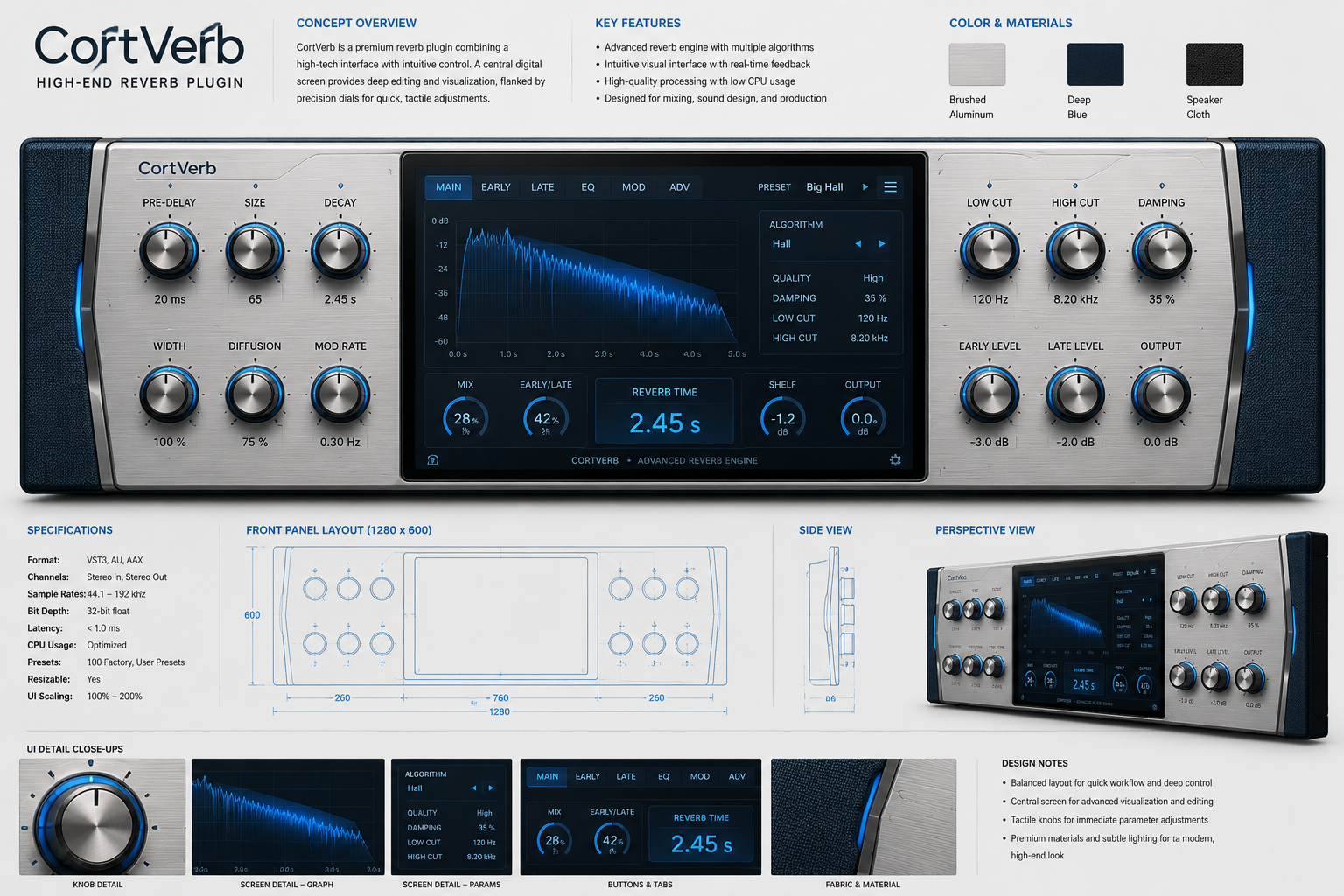
A premium VST3 reverb effect with a central digital screen for real-time decay visualization, brushed-steel control panels with 12 precision knobs, speaker-cloth side panels with LED strips, and a hardware-inspired aesthetic built for mixing, sound design, and production.
What it does
12 rotary knobs across two brushed-steel panels: pre-delay, size, decay, width, diffusion, mod rate, low cut, high cut, damping, early level, late level, and output. Every dimension of the reverb tail is at your fingertips.
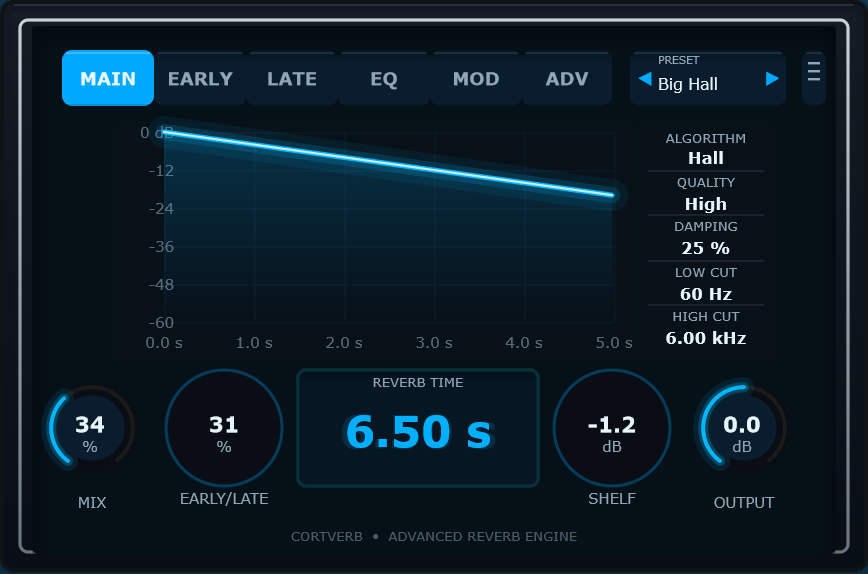
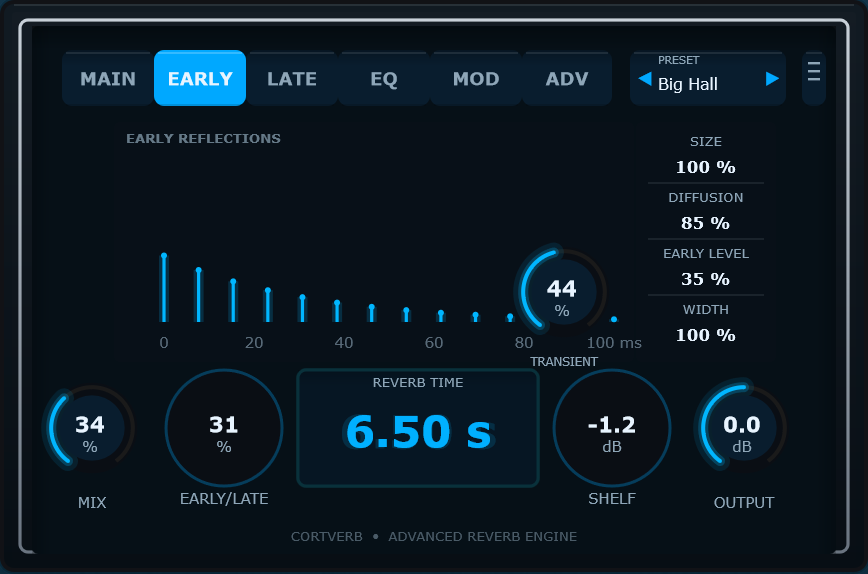
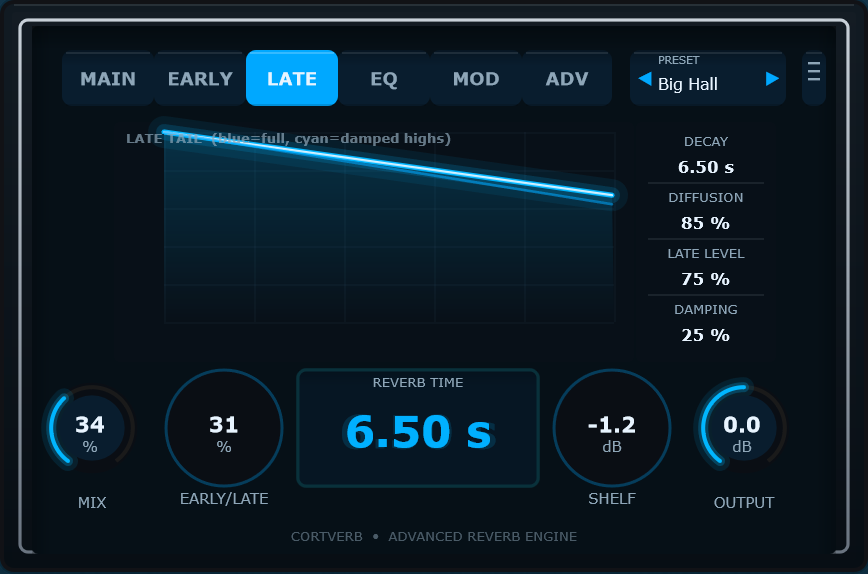
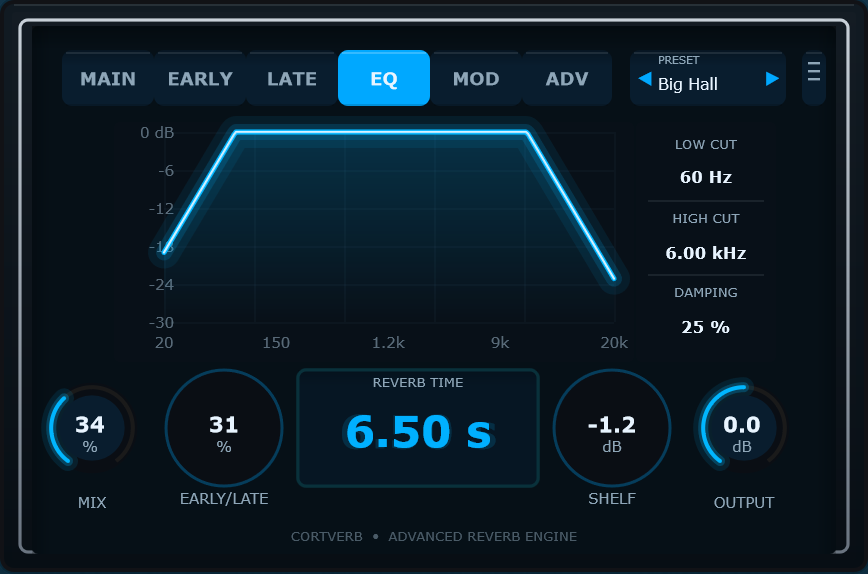
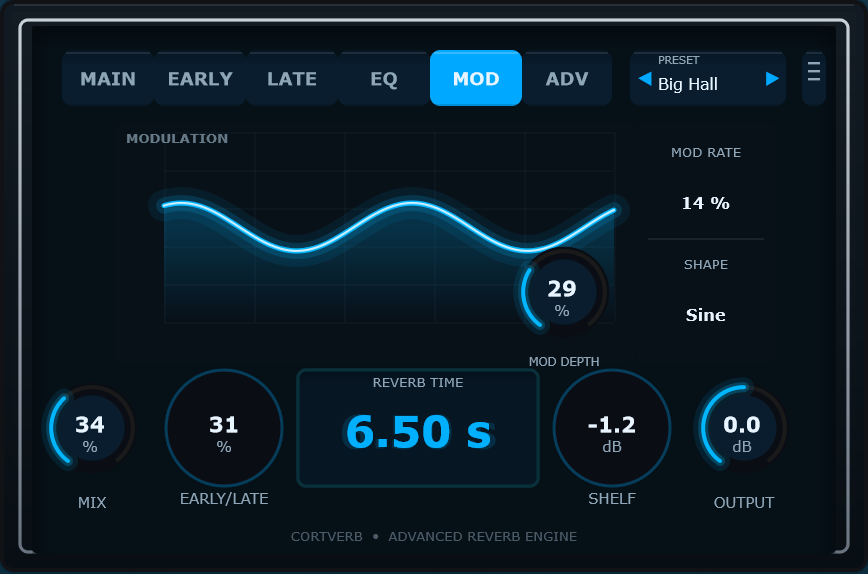
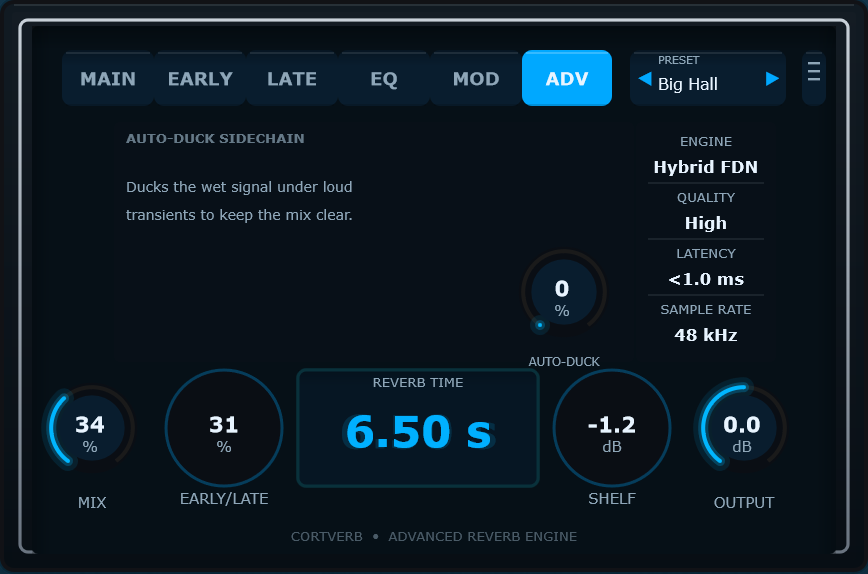
A central screen displays a live decay curve, parameter readouts, algorithm selection, and an early/late reflection ratio. See the reverb character change as you turn the knobs.
Choose from Hall, Room, Plate, and more. Each algorithm has its own character, from lush concert halls to tight studio rooms. Switchable from the central screen.
Six screen tabs — Main, Early, Late, EQ, Mod, and Advanced — give access to the full depth of the engine without cluttering the interface.
Brushed aluminum knob panels with chevron cuts, speaker-cloth side panels with blue LED strips, chamfered chassis bevels, and a dark hardware aesthetic. Designed to look like gear, not software.
Stereo in, stereo out, with efficient DSP that won't tax your session. Built with JUCE and C++ for real-time performance at any buffer size and sample rate.
Under the hood
CortVerb's interface is modeled after premium rack-mount hardware: a machined chassis with chamfered bevels, brushed-steel control panels secured with visible screws, and speaker-cloth fabric side panels with glowing LED indicators.
The central screen is a fully rendered digital display with an interactive decay curve, tabbed parameter pages, a preset browser, and live readouts that respond to every parameter change in real time.

Every detail
0 – 250 ms. Separates the dry signal from the reverb onset for clarity and depth.
Controls the perceived room size, from tight closets to vast cathedrals.
0.1 – 10 seconds. Sets how long the reverb tail sustains before fading to silence.
Stereo spread from mono to fully wide. Shape the spatial image of the reverb.
Density of reflections. Low for discrete echoes, high for smooth, washed tails.
Internal modulation speed. Adds subtle motion to prevent metallic resonances.
High-pass filter on the reverb signal. Keeps low-end clean and controlled.
Low-pass filter to darken the tail. Simulates air absorption and natural rolloff.
Frequency-dependent decay. Higher damping absorbs highs faster for warmth.
Volume of early reflections. Shapes the initial spatial impression.
Volume of the diffuse reverb tail. Balance against early reflections for character.
Master output level. Compensate for gain changes across different settings.
Technical
| Format | VST3, Standalone |
| Channels | Stereo In, Stereo Out |
| Sample Rates | 44.1 – 192 kHz |
| Bit Depth | 32-bit float |
| Latency | < 1.0 ms |
| CPU Usage | Optimized |
| UI Size | 1280 × 600 |
| Platform | Windows 10/11 (64-bit) |
| Built With | C++ / JUCE 8 |
Status
CortVerb is currently in active development. The interface, DSP engine, and preset system are being built out. A free download will be available here when it ships.
Questions or want to know when it drops?